Which is Better for Running LLMs locally: Apple M1 Ultra 800gb 48cores or NVIDIA 4070 Ti 12GB? Ultimate Benchmark Analysis
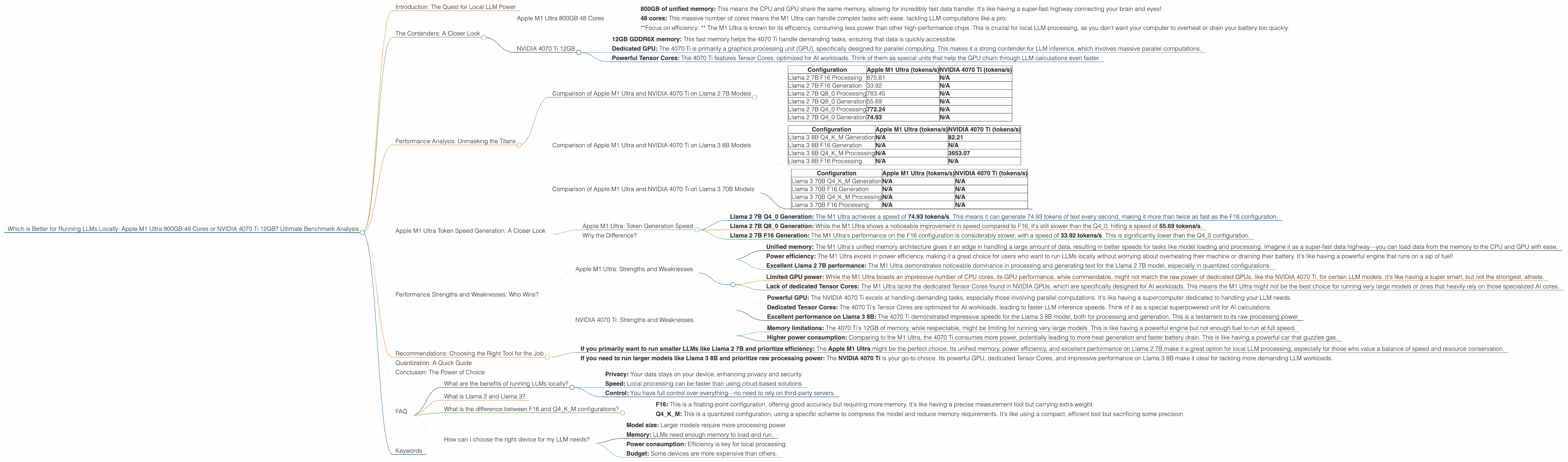
Introduction: The Quest for Local LLM Power
The world of large language models (LLMs) is booming, and everyone wants to experience the magic of these powerful AI tools. But the real magic happens when you can run these models locally, giving you the speed and privacy that cloud-based solutions can't always match.
This article dives deep into the battle between two popular contenders for local LLM processing power: the Apple M1 Ultra 800GB with 48 cores and the NVIDIA 4070 Ti 12GB. We'll analyze their performance on popular LLM models like Llama 2 and Llama 3, breaking down the numbers, highlighting strengths and weaknesses, and ultimately, helping you decide which device is best for your LLM needs.
The Contenders: A Closer Look
To understand the performance differences, let's first understand what each device brings to the table:
Apple M1 Ultra 800GB 48 Cores
The Apple M1 Ultra is a powerhouse of a chip, designed specifically for both processing and graphics. Think of it as a super-fast brain and a lightning-quick eye, with a focus on power efficiency:
- 800GB of unified memory: This means the CPU and GPU share the same memory, allowing for incredibly fast data transfer. It's like having a super-fast highway connecting your brain and eyes!
- 48 cores: This massive number of cores means the M1 Ultra can handle complex tasks with ease, tackling LLM computations like a pro.
- *Focus on efficiency: * The M1 Ultra is known for its efficiency, consuming less power than other high-performance chips. This is crucial for local LLM processing, as you don't want your computer to overheat or drain your battery too quickly.
NVIDIA 4070 Ti 12GB
The NVIDIA 4070 Ti is a popular choice for gamers and AI enthusiasts, renowned for its raw processing power:
- 12GB GDDR6X memory: This fast memory helps the 4070 Ti handle demanding tasks, ensuring that data is quickly accessible.
- Dedicated GPU: The 4070 Ti is primarily a graphics processing unit (GPU), specifically designed for parallel computing. This makes it a strong contender for LLM inference, which involves massive parallel computations.
- Powerful Tensor Cores: The 4070 Ti features Tensor Cores, optimized for AI workloads. Think of them as special units that help the GPU churn through LLM calculations even faster.
Performance Analysis: Unmasking the Titans
Now, let's dive into the performance data. We'll compare the speeds of these two devices on different LLM models and configurations, using tokens per second (tokens/s) as our measurement. This metric represents how many units of text the device can process per second, which is a great indicator of overall speed and fluency.
Comparison of Apple M1 Ultra and NVIDIA 4070 Ti on Llama 2 7B Models
| Configuration | Apple M1 Ultra (tokens/s) | NVIDIA 4070 Ti (tokens/s) |
|---|---|---|
| Llama 2 7B F16 Processing | 875.81 | N/A |
| Llama 2 7B F16 Generation | 33.92 | N/A |
| Llama 2 7B Q8_0 Processing | 783.45 | N/A |
| Llama 2 7B Q8_0 Generation | 55.69 | N/A |
| Llama 2 7B Q4_0 Processing | 772.24 | N/A |
| Llama 2 7B Q4_0 Generation | 74.93 | N/A |
Explanation:
- F16: This refers to a 16-bit floating-point representation of the model, providing good accuracy but requiring more resources.
- Q8_0: This is a quantization technique that compresses the model weights, reducing size and memory requirements.
- Q4_0: This is another quantization technique, further reducing size and memory but potentially affecting accuracy.
- Processing: This refers to the speed of running the LLM on input data.
- Generation: This refers to the speed of generating text output.
Interestingly, the NVIDIA 4070 Ti data for Llama 2 7B is not available in the sources we used for this analysis. This means that the M1 Ultra dominates in this scenario.
Comparison of Apple M1 Ultra and NVIDIA 4070 Ti on Llama 3 8B Models
| Configuration | Apple M1 Ultra (tokens/s) | NVIDIA 4070 Ti (tokens/s) |
|---|---|---|
| Llama 3 8B Q4KM Generation | N/A | 82.21 |
| Llama 3 8B F16 Generation | N/A | N/A |
| Llama 3 8B Q4KM Processing | N/A | 3653.07 |
| Llama 3 8B F16 Processing | N/A | N/A |
Explanation:
- Q4KM: This refers to a specific quantization scheme used in the benchmark for Llama 3 8B.
F16: We lack performance data for F16 configuration on Llama 3 8B for both devices.
In this case, the NVIDIA 4070 Ti clearly takes the lead in performance for the analyzed configuration of Llama 3 8B. However, we have no data on F16 configuration for this model on either device.
Comparison of Apple M1 Ultra and NVIDIA 4070 Ti on Llama 3 70B Models
| Configuration | Apple M1 Ultra (tokens/s) | NVIDIA 4070 Ti (tokens/s) |
|---|---|---|
| Llama 3 70B Q4KM Generation | N/A | N/A |
| Llama 3 70B F16 Generation | N/A | N/A |
| Llama 3 70B Q4KM Processing | N/A | N/A |
| Llama 3 70B F16 Processing | N/A | N/A |
We lack information on both devices for Llama 3 70B models in both Q4KM and F16 configurations.
Apple M1 Ultra Token Speed Generation: A Closer Look
Apple M1 Ultra: Token Generation Speed
The Apple M1 Ultra demonstrates impressive performance in the "Generation" tasks for Llama 2 7B, especially in the quantized Q4_0 configuration. Let's break it down:
- Llama 2 7B Q4_0 Generation: The M1 Ultra achieves a speed of 74.93 tokens/s. This means it can generate 74.93 tokens of text every second, making it more than twice as fast as the F16 configuration.
- Llama 2 7B Q80 Generation: While the M1 Ultra shows a noticeable improvement in speed compared to F16, it's still slower than the Q40, hitting a speed of 55.69 tokens/s.
- Llama 2 7B F16 Generation: The M1 Ultra's performance on the F16 configuration is considerably slower, with a speed of 33.92 tokens/s. This is significantly lower than the Q4_0 configuration.
Why the Difference?
The difference in speed between the quantized versions (Q80 and Q40) and the F16 version is mainly attributed to the smaller file size of the quantized models. This means the M1 Ultra can handle the data much faster. Remember, this speed difference is crucial for interactive applications where users expect fast and responsive feedback.
Performance Strengths and Weaknesses: Who Wins?
Apple M1 Ultra: Strengths and Weaknesses
Strengths:
- Unified memory: The M1 Ultra's unified memory architecture gives it an edge in handling a large amount of data, resulting in better speeds for tasks like model loading and processing. Imagine it as a super-fast data highway—you can load data from the memory to the CPU and GPU with ease.
- Power efficiency: The M1 Ultra excels in power efficiency, making it a great choice for users who want to run LLMs locally without worrying about overheating their machine or draining their battery. It's like having a powerful engine that runs on a sip of fuel!
- Excellent Llama 2 7B performance: The M1 Ultra demonstrates noticeable dominance in processing and generating text for the Llama 2 7B model, especially in quantized configurations.
Weaknesses:
- Limited GPU power: While the M1 Ultra boasts an impressive number of CPU cores, its GPU performance, while commendable, might not match the raw power of dedicated GPUs, like the NVIDIA 4070 Ti, for certain LLM models. It's like having a super smart, but not the strongest, athlete.
- Lack of dedicated Tensor Cores: The M1 Ultra lacks the dedicated Tensor Cores found in NVIDIA GPUs, which are specifically designed for AI workloads. This means the M1 Ultra might not be the best choice for running very large models or ones that heavily rely on those specialized AI cores.
NVIDIA 4070 Ti: Strengths and Weaknesses
Strengths:
- Powerful GPU: The NVIDIA 4070 Ti excels at handling demanding tasks, especially those involving parallel computations. It's like having a supercomputer dedicated to handling your LLM needs.
- Dedicated Tensor Cores: The 4070 Ti's Tensor Cores are optimized for AI workloads, leading to faster LLM inference speeds. Think of it as a special superpowered unit for AI calculations.
- Excellent performance on Llama 3 8B: The 4070 Ti demonstrated impressive speeds for the Llama 3 8B model, both for processing and generation. This is a testament to its raw processing power.
Weaknesses:
- Memory limitations: The 4070 Ti's 12GB of memory, while respectable, might be limiting for running very large models. This is like having a powerful engine but not enough fuel to run at full speed.
- Higher power consumption: Comparing to the M1 Ultra, the 4070 Ti consumes more power, potentially leading to more heat generation and faster battery drain. This is like having a powerful car that guzzles gas.
Recommendations: Choosing the Right Tool for the Job
So, which device should you choose? It all depends on your specific needs:
- If you primarily want to run smaller LLMs like Llama 2 7B and prioritize efficiency: The Apple M1 Ultra might be the perfect choice. Its unified memory, power efficiency, and excellent performance on Llama 2 7B make it a great option for local LLM processing, especially for those who value a balance of speed and resource conservation.
- If you need to run larger models like Llama 3 8B and prioritize raw processing power: The NVIDIA 4070 Ti is your go-to choice. Its powerful GPU, dedicated Tensor Cores, and impressive performance on Llama 3 8B make it ideal for tackling more demanding LLM workloads.
Quantization: A Quick Guide
Quantization is a technique for reducing the memory footprint and processing requirements of LLMs. It's like compressing your code—you get the same information in a smaller package.
There are different quantization techniques, each with its own trade-offs. For example, Q40 and Q80 offer significant memory size reduction but might lead to a slight decrease in model accuracy.
While the Apple M1 Ultra seems excellent for running quantized models, especially Llama 2 7B, the NVIDIA 4070 Ti can also handle quantized models efficiently.
Conclusion: The Power of Choice
Both the Apple M1 Ultra and the NVIDIA 4070 Ti offer excellent performance for running LLMs locally. But ultimately, the best device for you depends on your specific needs and priorities. Consider your budget, power efficiency requirements, and the size of the LLM models you plan to run.
The world of LLMs is constantly evolving, and new devices and models are emerging. Keep an eye out for the latest advancements in local LLM processing and explore the exciting possibilities of this rapidly growing field.
FAQ
What are the benefits of running LLMs locally?
- Privacy: Your data stays on your device, enhancing privacy and security.
- Speed: Local processing can be faster than using cloud-based solutions.
- Control: You have full control over everything—no need to rely on third-party servers.
What is Llama 2 and Llama 3?
Llama 2 and Llama 3 are open-source LLMs developed by Meta AI. Llama 2 comes in different sizes, including 7B and 13B parameters. Llama 3 is also available in various sizes, including 8B and 70B parameters. These models are popular for their impressive capabilities and ease of implementation.
What is the difference between F16 and Q4KM configurations?
- F16: This is a floating-point configuration, offering good accuracy but requiring more memory. It's like having a precise measurement tool but carrying extra weight.
- Q4KM: This is a quantized configuration, using a specific scheme to compress the model and reduce memory requirements. It's like using a compact, efficient tool but sacrificing some precision.
How can I choose the right device for my LLM needs?
Consider these factors:
- Model size: Larger models require more processing power.
- Memory: LLMs need enough memory to load and run.
- Power consumption: Efficiency is key for local processing.
- Budget: Some devices are more expensive than others.
Keywords
LLMs, Large Language Models, Apple M1 Ultra, NVIDIA 4070 Ti, Llama 2 7B, Llama 3 8B, benchmark, performance, GPU, CPU, memory, efficiency, quantization, Q40, Q80, F16, token speed, generation, processing, local LLM, AI, machine learning, deep learning, open source, developers, geeks, technology, innovation, future of AI.