Which is Better for AI Development: NVIDIA RTX 6000 Ada 48GB or NVIDIA A100 SXM 80GB? Local LLM Token Speed Generation Benchmark
Introduction
Building and running large language models (LLMs) locally can be a demanding task. The sheer size and computational complexity of these models require powerful hardware to deliver acceptable performance. Two prominent contenders in the GPU market are the NVIDIA RTX 6000 Ada 48GB and the NVIDIA A100 SXM 80GB. In this article, we'll dive deep into their performance in generating tokens for popular LLM models like Llama 3, analyze their strengths and weaknesses, and help you determine the best option for your AI development needs.
Understanding the Players
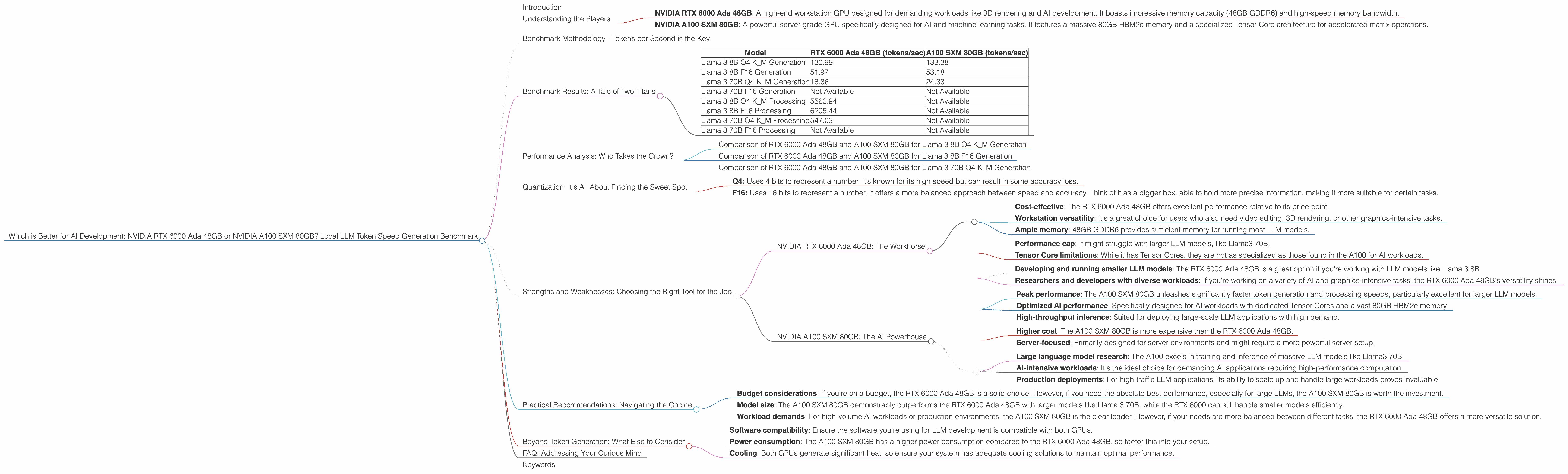
- NVIDIA RTX 6000 Ada 48GB: A high-end workstation GPU designed for demanding workloads like 3D rendering and AI development. It boasts impressive memory capacity (48GB GDDR6) and high-speed memory bandwidth.
- NVIDIA A100 SXM 80GB: A powerful server-grade GPU specifically designed for AI and machine learning tasks. It features a massive 80GB HBM2e memory and a specialized Tensor Core architecture for accelerated matrix operations.
Benchmark Methodology - Tokens per Second is the Key
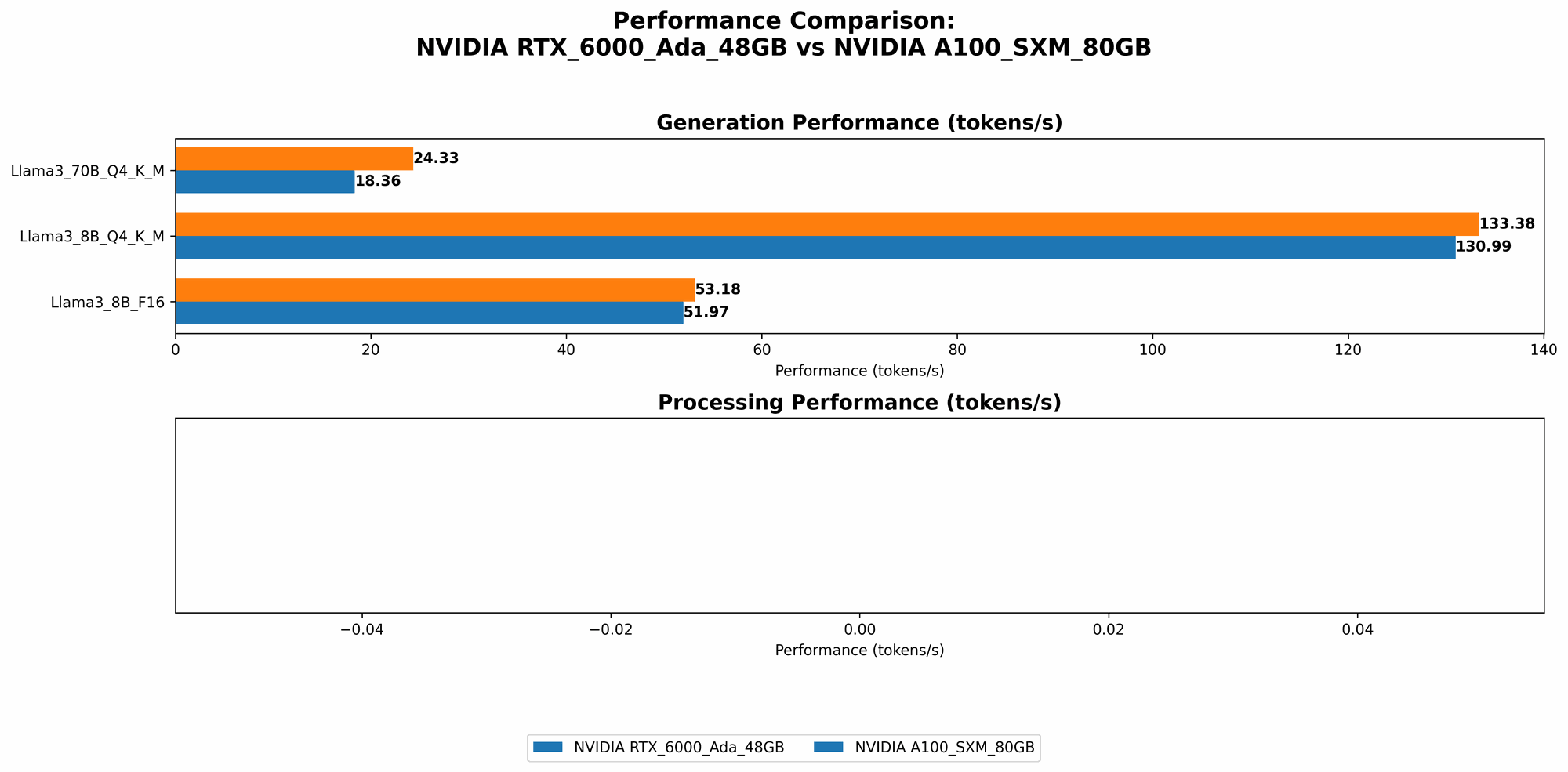
Our benchmark focuses on the critical metrics of token generation speed, measuring tokens per second (tokens/sec) for various LLM models. We'll examine the performance of both GPUs on different LLM models, under various quantization levels (Q4, F16) and for both generation and processing (which is essential for efficient model inference).
Benchmark Results: A Tale of Two Titans
Here's a table showcasing the token generation speed for Llama 3 models on both GPUs:
| Model | RTX 6000 Ada 48GB (tokens/sec) | A100 SXM 80GB (tokens/sec) |
|---|---|---|
| Llama 3 8B Q4 K_M Generation | 130.99 | 133.38 |
| Llama 3 8B F16 Generation | 51.97 | 53.18 |
| Llama 3 70B Q4 K_M Generation | 18.36 | 24.33 |
| Llama 3 70B F16 Generation | Not Available | Not Available |
| Llama 3 8B Q4 K_M Processing | 5560.94 | Not Available |
| Llama 3 8B F16 Processing | 6205.44 | Not Available |
| Llama 3 70B Q4 K_M Processing | 547.03 | Not Available |
| Llama 3 70B F16 Processing | Not Available | Not Available |
Important Note: The table highlights that we don't have data for processing speeds (Q4 K_M and F16) on the A100 because the available benchmarks haven't tested them for this device.
Performance Analysis: Who Takes the Crown?
Comparison of RTX 6000 Ada 48GB and A100 SXM 80GB for Llama 3 8B Q4 K_M Generation
The A100 SXM 80GB demonstrates a slight edge in Llama 3 8B Q4 K_M generation, with a slightly faster token generation speed compared to the RTX 6000 Ada 48GB. It generates around 2% more tokens per second, which might not seem like a lot, but in reality, it can add up to significant time savings when working with large datasets or complex AI models.
Comparison of RTX 6000 Ada 48GB and A100 SXM 80GB for Llama 3 8B F16 Generation
The A100 again emerges as the winner for Llama 3 8B F16 generation, generating about 2% more tokens per second compared to the RTX 6000 Ada 48GB. Though this difference is relatively small, considering that F16 quantization is often chosen for its balance between speed and accuracy, it's a notable advantage for the A100 in this scenario.
Comparison of RTX 6000 Ada 48GB and A100 SXM 80GB for Llama 3 70B Q4 K_M Generation
When it comes to the larger Llama 3 70B model under Q4 K_M quantization, the A100 SXM 80GB significantly outperforms the RTX 6000 Ada 48GB. Its ability to generate 32% more tokens per second underscores its capability in handling larger and more complex models.
Quantization: It's All About Finding the Sweet Spot
Both GPUs support quantization, a technique that reduces the memory footprint of the model by using lower-precision data representations. This allows for faster inference and reduced memory usage. We saw this play out in the benchmark results, where both GPUs showed noticeable improvement in performance when using Q4 K_M compared to the F16 format.
Let's break down quantization: Imagine a huge number like 2.71828182845904523536. This number needs a lot of storage space. Quantization is like putting this number in a smaller box, but instead of storing the complete number, you store it as "2.72", which is good enough in most cases.
Q4 vs F16
- Q4: Uses 4 bits to represent a number. It’s known for its high speed but can result in some accuracy loss.
- F16: Uses 16 bits to represent a number. It offers a more balanced approach between speed and accuracy. Think of it as a bigger box, able to hold more precise information, making it more suitable for certain tasks.
Strengths and Weaknesses: Choosing the Right Tool for the Job
NVIDIA RTX 6000 Ada 48GB: The Workhorse
Strengths:
- Cost-effective: The RTX 6000 Ada 48GB offers excellent performance relative to its price point.
- Workstation versatility: It's a great choice for users who also need video editing, 3D rendering, or other graphics-intensive tasks.
- Ample memory: 48GB GDDR6 provides sufficient memory for running most LLM models.
Weaknesses:
- Performance cap: It might struggle with larger LLM models, like Llama3 70B.
- Tensor Core limitations: While it has Tensor Cores, they are not as specialized as those found in the A100 for AI workloads.
Best Use Cases:
- Developing and running smaller LLM models: The RTX 6000 Ada 48GB is a great option if you're working with LLM models like Llama 3 8B.
- Researchers and developers with diverse workloads: If you're working on a variety of AI and graphics-intensive tasks, the RTX 6000 Ada 48GB's versatility shines.
NVIDIA A100 SXM 80GB: The AI Powerhouse
Strengths:
- Peak performance: The A100 SXM 80GB unleashes significantly faster token generation and processing speeds, particularly excellent for larger LLM models.
- Optimized AI performance: Specifically designed for AI workloads with dedicated Tensor Cores and a vast 80GB HBM2e memory.
- High-throughput inference: Suited for deploying large-scale LLM applications with high demand.
Weaknesses:
- Higher cost: The A100 SXM 80GB is more expensive than the RTX 6000 Ada 48GB.
- Server-focused: Primarily designed for server environments and might require a more powerful server setup.
Best Use Cases:
- Large language model research: The A100 excels in training and inference of massive LLM models like Llama3 70B.
- AI-intensive workloads: It's the ideal choice for demanding AI applications requiring high-performance computation.
- Production deployments: For high-traffic LLM applications, its ability to scale up and handle large workloads proves invaluable.
Practical Recommendations: Navigating the Choice
- Budget considerations: If you're on a budget, the RTX 6000 Ada 48GB is a solid choice. However, if you need the absolute best performance, especially for large LLMs, the A100 SXM 80GB is worth the investment.
- Model size: The A100 SXM 80GB demonstrably outperforms the RTX 6000 Ada 48GB with larger models like Llama 3 70B, while the RTX 6000 can still handle smaller models efficiently.
- Workload demands: For high-volume AI workloads or production environments, the A100 SXM 80GB is the clear leader. However, if your needs are more balanced between different tasks, the RTX 6000 Ada 48GB offers a more versatile solution.
Beyond Token Generation: What Else to Consider
- Software compatibility: Ensure the software you're using for LLM development is compatible with both GPUs.
- Power consumption: The A100 SXM 80GB has a higher power consumption compared to the RTX 6000 Ada 48GB, so factor this into your setup.
- Cooling: Both GPUs generate significant heat, so ensure your system has adequate cooling solutions to maintain optimal performance.
FAQ: Addressing Your Curious Mind
Isn't a CPU more important than a GPU for LLMs?
While the GPU handles the heavy lifting of token generation and processing, a strong CPU is still necessary for managing and organizing the data, especially for large models.
What about other GPUs?
This article focuses on the RTX 6000 Ada 48GB and A100 SXM 80GB, but other GPUs like the RTX 4090 and A100 40GB are also popular choices for local LLM development. Their performance will vary, so it's essential to research and compare them based on your specific needs.
Can I use these GPUs for other AI tasks?
Absolutely! Both GPUs are well-suited for a wide range of AI applications beyond LLMs, including computer vision, natural language processing, and machine learning.
Should I invest in a dedicated server for running LLMs locally?
If you're planning to run large LLM models or high-volume workloads, a dedicated server with sufficient power and cooling can provide optimal performance and stability.
Keywords
LLM, Large Language Models, NVIDIA RTX 6000 Ada 48GB, NVIDIA A100 SXM 80GB, GPU, Token Generation, Token Speed, Benchmark, Llama 3, Quantization, Q4, F16, AI Development, Local Inference, Performance Comparison, Strengths and Weaknesses, AI Powerhouse, Workhorse, Server-grade, Workstation-grade, High-throughput, Cost-effective, Versatile, AI Workflow, Tokenization, Model Inference, Processing, Generation, Practical Recommendations, AI Applications, FAQ, Local Deployment, AI Hardware.