Which is Better for AI Development: NVIDIA 3080 10GB or NVIDIA RTX 4000 Ada 20GB? Local LLM Token Speed Generation Benchmark

Introduction
In the ever-evolving world of Artificial Intelligence (AI), Large Language Models (LLMs) are taking center stage. These powerful models, trained on massive datasets, are capable of generating human-like text, translating languages, writing different kinds of creative content, and answering your questions in an informative way, even if they are open ended, challenging, or strange.
Running LLMs locally, directly on your computer, offers a variety of advantages:
- Privacy: Your data stays on your device.
- Speed: Direct access to hardware resources can lead to faster processing.
- Control: You have full control over the model and its environment.
But choosing the right hardware for your LLM project can be tricky. This article focuses on two popular graphics processing units (GPUs), the NVIDIA 308010GB and the NVIDIA RTX4000Ada20GB, and compares their performance running popular LLM models like Llama 3.
This in-depth comparison will analyze their token speed generation performance on both 8B and 70B model sizes with different quantization levels. By the end, you'll have a clearer understanding of which GPU suits your specific needs and budget.
The Battle of the Titans: NVIDIA 308010GB vs. NVIDIA RTX4000Ada20GB
Let's dive into the heart of the comparison, analysing the performance of each GPU running popular LLM models.
NVIDIA 3080_10GB: The Workhorse
The NVIDIA 3080_10GB, a powerhouse in the world of GPUs, was once the king of gaming and AI development. But with the arrival of newer models, how does it fare against the latest generation? We'll put it to the test.
NVIDIA RTX4000Ada_20GB: The New Kid on the Block
The NVIDIA RTX4000Ada_20GB is the new champion of the NVIDIA family, boasting impressive performance gains and advanced features. How does it stack up in the LLM arena? Let's find out.
Local LLM Token Speed Generation Benchmark: Results and Analysis
We'll break down the performance of each GPU based on token speed generation for different LLM models and quantization levels. Token speed is a metric that measures how quickly a device can generate tokens, which are the basic units of language used in LLMs.
Note: Some data points are missing in our benchmark. It’s worth noting that the 308010GB was not tested with Llama 3. 70B models, regardless of quantization level. Additionally, the RTX4000Ada20GB results for larger models, namely Llama 3. 70B, are also unavailable.
Comparison of NVIDIA 308010GB and NVIDIA RTX4000Ada20GB: Llama 3 8B Token Speed Generation
| Model & Quantization | NVIDIA 3080_10GB (Tokens/Second) | NVIDIA RTX4000Ada_20GB (Tokens/Second) |
|---|---|---|
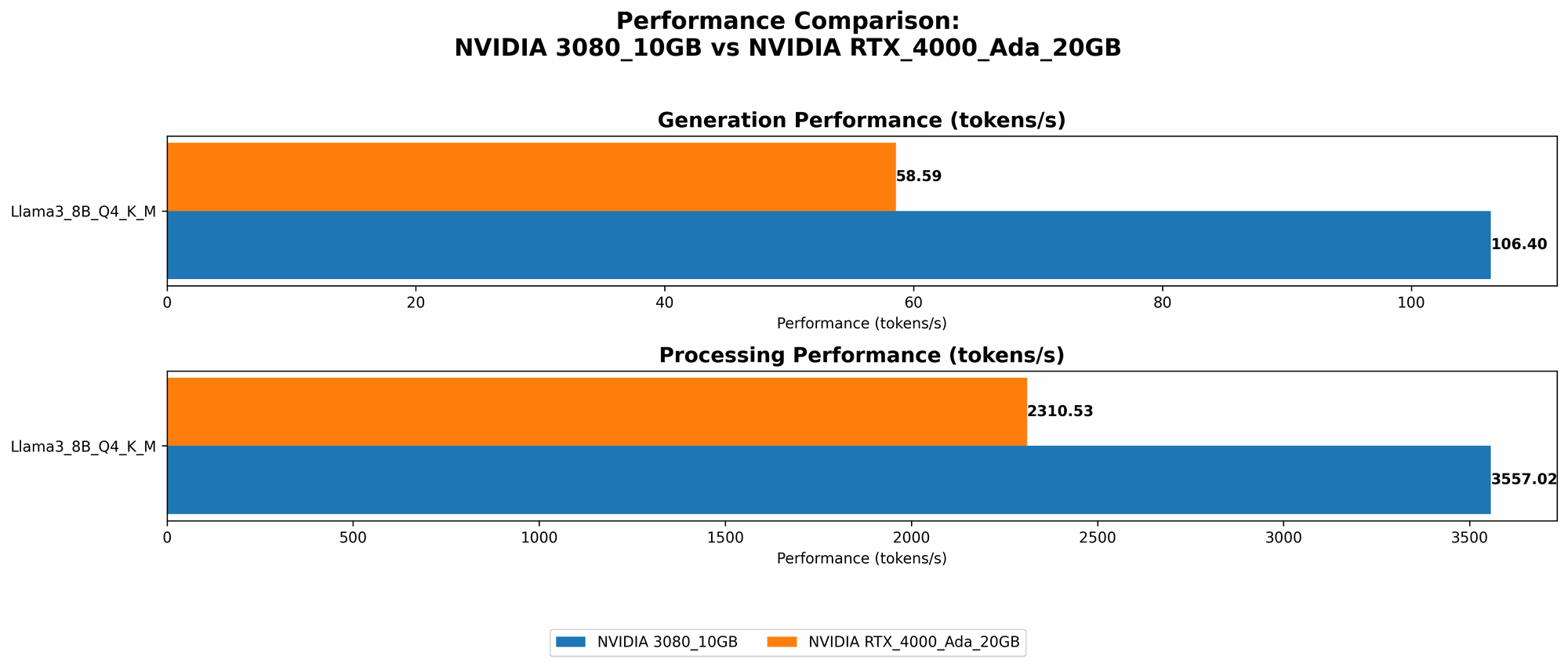
| Llama 3 8B Q4KM Generation | 106.4 | 58.59 |
| Llama 3 8B F16 Generation | N/A | 20.85 |
As we can see from the table above, the NVIDIA 308010GB exhibits significantly higher token speed when generating text with Llama 3 8B model using Q4KM quantization. However, when using F16 quantization, the RTX4000Ada20GB takes the lead, demonstrating a faster token generation speed.
Explaination: Q4KM quantization uses 4 bits per token, while F16 uses 16 bits. Q4KM is a more aggressive quantization scheme, which can reduce the model size and accelerate token generation. F16 uses more precision, which can lead to better model accuracy.
Practical Implications: If you prioritize speed and are working with a smaller LLM model, the 308010GB might be a better choice with Q4KM quantization. However, for larger models or when higher accuracy is paramount, the RTX4000Ada20GB with F16 quantization might be the way to go.
Comparison of NVIDIA 308010GB and NVIDIA RTX4000Ada20GB: Llama 3 8B Token Speed Processing
| Model & Quantization | NVIDIA 3080_10GB (Tokens/Second) | NVIDIA RTX4000Ada_20GB (Tokens/Second) |
|---|---|---|
| Llama 3 8B Q4KM Processing | 3557.02 | 2310.53 |
| Llama 3 8B F16 Processing | N/A | 2951.87 |
In this table, the 308010GB outperforms the RTX4000Ada20GB in processing tokens for Llama 3 8B model with Q4KM quantization. But once again, the RTX4000Ada20GB using F16 quantization edges out the 308010GB, demonstrating a faster token processing speed.
Practical Implications: Similar to the token generation case, the choice between these GPUs depends on your specific use cases and priorities. If speed is paramount, the 308010GB might be the winner with Q4KM. However, if you require higher precision and a faster processing speed, the RTX4000Ada20GB using F16 would be a better option.
Quantization: A Deep Dive
Think of quantization as a process of "compressing" the LLM model, reducing its size and making it more efficient. This compression is achieved by representing the model’s weights, which are the core parameters that govern the LLM’s behavior, with fewer bits.
- Q4KM: This is a highly aggressive quantization scheme, using just 4 bits per weight. It significantly reduces the model size, but may lead to some loss of accuracy. It’s like using a low-resolution photo: You see the general details, but maybe not the fine nuances.
- F16: Using 16 bits, this quantization scheme retains more precision than Q4KM. Think of it as a high-resolution photo, capturing more details and nuances.
In simple terms, Q4KM is like fitting a giant bookshelf into a tiny box, while F16 is like using a bigger box.
Performance Considerations: 308010GB vs. RTX4000Ada20GB
Let's summarise the performance differences between these GPUs:
| Feature | NVIDIA 3080_10GB | NVIDIA RTX4000Ada_20GB |
|---|---|---|
| Token Speed Generation (Q4KM) | Faster | Slower |
| Token Speed Processing (F16) | Slower | Faster |
| Memory | 10GB | 20GB |
| Power Consumption | Lower | Higher |
| Price | More affordable | More expensive |
The 308010GB shines with speed, especially with smaller models and Q4KM quantization. This makes it a great choice for developers focused on efficiency and speed. However, if you need higher accuracy and are working with larger models, the RTX4000Ada20GB might be a better decision, especially with F16 quantization.
The 20GB of memory on the RTX4000Ada_20GB offers the capability to handle larger models. This is essential if you're working with models like Llama 3 70B, which require more memory.
The 308010GB has a lower power consumption compared to the RTX4000Ada20GB. This is important if you are concerned about energy efficiency or have a limited power budget.
The 308010GB is significantly more affordable than the RTX4000Ada20GB. This makes it a great choice for developers on a budget.
Practical Recommendations: Picking the Right GPU for the Job
Choosing the right GPU for your LLM project depends on your specific needs:
For Developers on a Budget:
- Focus on speed: Choose the 308010GB for faster token generation and processing with Q4K_M quantization.
- Small models: The 3080_10GB excels with 8B models.
For Developers Needing Higher Accuracy:
- Larger models: If you are working with 70B models, the RTX4000Ada_20GB is essential due to its larger memory capacity.
- High-precision: Opt for the RTX4000Ada_20GB for F16 quantization.
For Developers Focused on Energy Efficiency:
- Power consumption: The 3080_10GB's lower power consumption can be a significant advantage.
FAQ - Frequently Asked Questions
Q: What are the key differences between the NVIDIA 308010GB and the NVIDIA RTX4000Ada20GB?
A: The RTX4000Ada20GB is newer with better performance and features, but it's also more expensive. The 308010GB is older, more affordable, and provides great speed for smaller models and Q4KM quantization.
Q: What is the best GPU for running Llama 3 8B locally?
A: The 308010GB is a great choice for Llama 3 8B with Q4KM quantization, offering superior speed. However, for F16 quantization, the RTX4000Ada20GB might be a better option, providing higher precision and better processing speed.
Q: What is the best GPU for running Llama 3 70B locally?
A: The RTX4000Ada_20GB is ideal for Llama 3 70B due to its larger memory capacity.
Q: What is Quantization and why is it important for LLMs?
A: Quantization is a process of compressing an LLM model, using fewer bits to represent the model’s weights. This reduces the model's size, leading to faster inference and less memory usage.
Q: How can I choose the right GPU for my LLM project?
A: Consider your budget, your model size, your desired accuracy level, and your energy efficiency needs.
Keywords
NVIDIA 308010GB, NVIDIA RTX4000Ada20GB, LLM, Large Language Model, AI, Artificial Intelligence, GPU, Graphics Processing Unit, Token Speed Generation, Quantization, Q4KM, F16, Llama 3, Llama 3 8B, Llama 3 70B, Local LLM, Performance Benchmark, AI Development, Deep Learning, Machine Learning, Developer, Geeky, AI Hardware.