Which is Better for AI Development: NVIDIA 3080 10GB or NVIDIA 4090 24GB x2? Local LLM Token Speed Generation Benchmark

Introduction
The world of large language models (LLMs) is exploding, and with it, the need for powerful hardware to run these models locally. Whether you're a developer tinkering with the latest advancements in AI or a researcher pushing the boundaries of natural language processing, having the right hardware is crucial for achieving optimal performance.
But with so many options available, choosing the right setup can be overwhelming. This article dives deep into the performance of two popular GPUs, the NVIDIA 3080 10GB and the NVIDIA 4090 24GB x2, specifically in the context of local LLM token speed generation. We'll analyze their strengths and weaknesses, comparing their performance using real-world data and provide guidance on which setup might be best suited for your needs.
The Need for Speed: Token Generation in LLMs
Think of an LLM as a sophisticated language machine. It's trained on massive amounts of text data and can generate human-like text, translate languages, write different kinds of creative content, and answer your questions in an informative way. However, this incredible ability comes at a cost: processing power.
When you ask an LLM a question or give it a prompt, it needs to analyze the words, understand their meaning, and then generate a response. This process involves breaking down the text into individual units called "tokens," which are like small pieces of information the LLM can comprehend.
The more tokens an LLM can process per second, the faster it can generate responses. This is where the GPU comes in. It acts as the engine that powers the LLM, handling the complex calculations and processing needed for token generation.
Comparing Token Speed: NVIDIA 3080 10GB vs. NVIDIA 4090 24GB x2
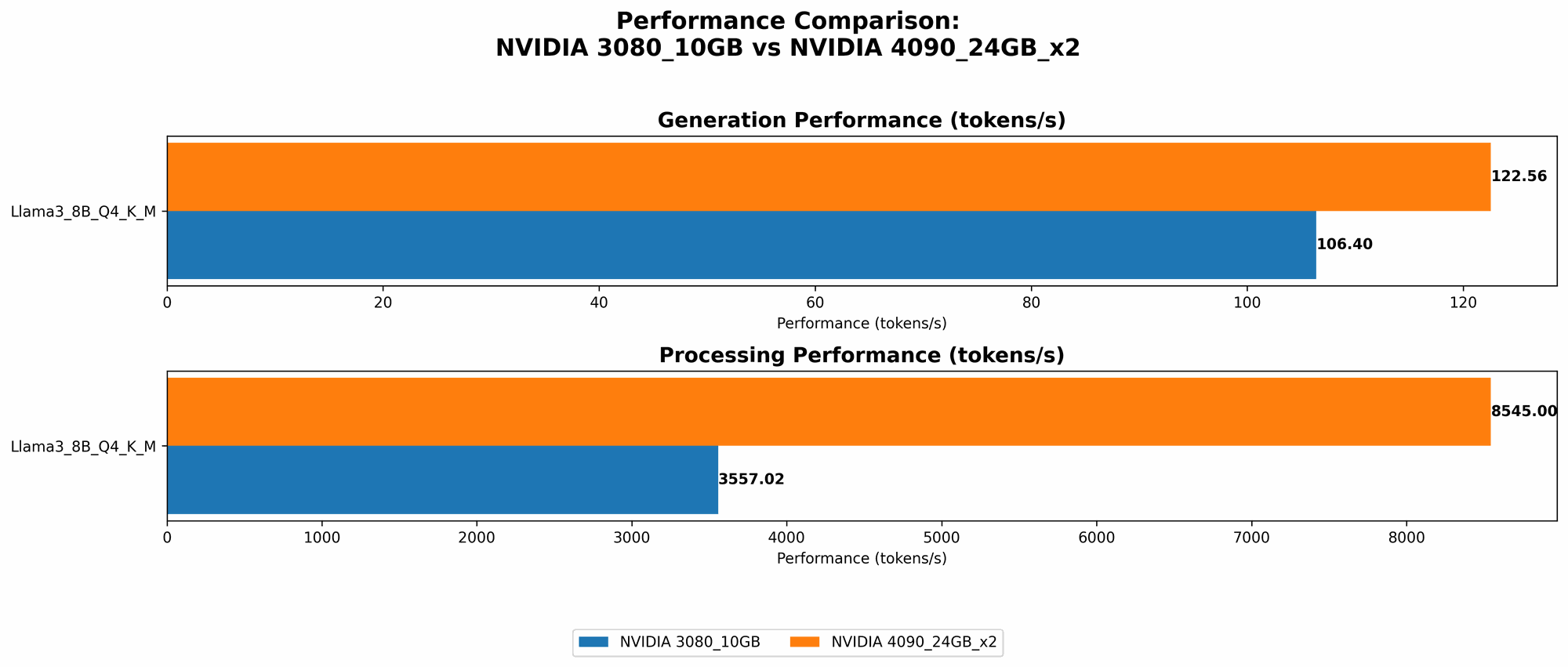
To understand the performance difference between the NVIDIA 3080 10GB and the NVIDIA 4090 24GB x2, we'll dive into some real-world benchmark data. The following table summarizes the token generation speed for various LLM models on both configurations, measured in tokens per second:
| Model | NVIDIA 3080 10GB (Tokens/Second) | NVIDIA 4090 24GB x2 (Tokens/Second) |
|---|---|---|
| Llama 3 8B Quantized (Q4KM) | 106.4 | 122.56 |
| Llama 3 8B FP16 | N/A | 53.27 |
| Llama 3 70B Quantized (Q4KM) | N/A | 19.06 |
| Llama 3 70B FP16 | N/A | N/A |
Performance Analysis: Breaking Down the Numbers
Smaller Models (Llama 3 8B): The NVIDIA 4090 24GB x2 significantly outperforms the NVIDIA 3080 10GB in both quantized and FP16 configurations. The NVIDIA 4090 24GB x2 delivers about 15% more tokens per second with quantized weights and almost double the speed with FP16 weights.
Larger Models (Llama 3 70B): The NVIDIA 3080 10GB lacks the memory and processing power to handle the Llama 3 70B model, making it unsuitable for these larger language models. The NVIDIA 4090 24GB x2, on the other hand, can run the Llama 3 70B model, albeit at a substantially slower pace than the smaller 8B model.
Quantization vs. FP16: The quantized model (Q4KM) typically offers better performance compared to the FP16 model because it uses a less precise representation of the weights, allowing for faster computation. However, the FP16 model often provides higher accuracy, especially for more complex tasks or if you need fine-grained control over the model's behavior.
Strengths and Weaknesses
NVIDIA 3080 10GB
Strengths:
- Cost-Effective: The NVIDIA 3080 10GB is a more affordable option compared to the dual 4090 setup.
- Suitable for Smaller Models: It's a good choice for running smaller LLM models like Llama 3 8B, especially if you're on a budget.
- Lower Power Consumption: Compared to the dual 4090 setup, it consumes less energy, which can translate to lower electricity bills, especially if you run the GPU for extended periods.
Weaknesses:
- Limited Memory: The 10GB of VRAM makes it unsuitable for larger LLMs, like the Llama 3 70B.
- Lower Performance: Significantly slower than the dual 4090 setup, especially with larger models that require more memory and processing power.
NVIDIA 4090 24GB x2
Strengths:
- Exceptional Performance: Delivers significantly faster token generation speeds, especially with the larger Llama 3 70B model.
- High Memory Capacity: The combined 48GB of VRAM is sufficient for running even the largest LLM models, providing flexibility and scalability.
- Future-Proof: The dual 4090 setup can handle the increasing demands of future, even larger LLMs.
Weaknesses:
- High Cost: The dual 4090 setup is incredibly expensive, making it an impractical choice for many developers or researchers.
- High Power Consumption: Consuming substantially more power than the 3080 10GB, potentially leading to higher electricity bills.
- Thermal Management: Managing the heat generated by two high-end GPUs can be challenging, requiring robust cooling solutions to avoid thermal throttling and performance degradation.
Practical Recommendations
- Developers Working with Smaller Models: The NVIDIA 3080 10GB offers a cost-effective solution for working with smaller LLMs like Llama 3 8B.
- Researchers or Enterprises Running Large-Scale LLMs: The NVIDIA 4090 24GB x2 is the go-to choice for running large language models like Llama 3 70B, offering exceptional performance and scalability.
- Budget-Conscious Users: If budget is a primary concern, the NVIDIA 3080 10GB is a viable option for experimenting with local LLMs.
- High-Performance Enthusiasts: If you require top-of-the-line performance and have no budget constraints, the NVIDIA 4090 24GB x2 setup is the clear winner.
Conclusion
Choosing the right hardware for local LLM development depends on your specific needs, budget, and the scale of your projects. While the NVIDIA 3080 10GB is more affordable and sufficient for smaller models, the NVIDIA 4090 24GB x2 offers unmatched performance and memory capacity for larger language models. Ultimately, the best setup is the one that aligns with your budget, performance expectations, and the size of the LLM models you plan to work with.
FAQ
What is quantization and why is it important?
Quantization is like simplifying a complex recipe by using fewer ingredients. In LLMs, it involves reducing the precision of numbers that represent the model's weights. This simplification leads to smaller model sizes, faster loading times, and often, faster inference.
How do I choose between an NVIDIA 3080 10GB and an NVIDIA 4090 24GB x2?
Consider your budget, the size of the LLM models you'll be working with, and your performance requirements. For smaller models and budget-conscious users, the NVIDIA 3080 10GB is a good choice. For larger models and higher performance demands, the NVIDIA 4090 24GB x2 is recommended.
What are some other alternatives to these devices?
Other high-end GPUs like the NVIDIA 4080 16GB or the AMD Radeon RX 7900 XT can also be considered for local LLM development. However, the NVIDIA 4090 24GB x2 currently offers the best performance for large-scale models.
What are the future trends in local LLM processing?
We can expect to see continued advancements in GPU technology, with even more powerful and efficient GPUs specifically designed for AI workloads. Additionally, advancements in software, such as optimized frameworks and libraries, will further enhance local LLM performance.
Keywords
LLM, Large Language Model, Token Speed, NVIDIA 3080, NVIDIA 4090, GPU, Local Inference, AI Development, Quantization, FP16, Benchmark, Performance