Which is Better for AI Development: Apple M1 Max 400gb 24cores or NVIDIA 3070 8GB? Local LLM Token Speed Generation Benchmark
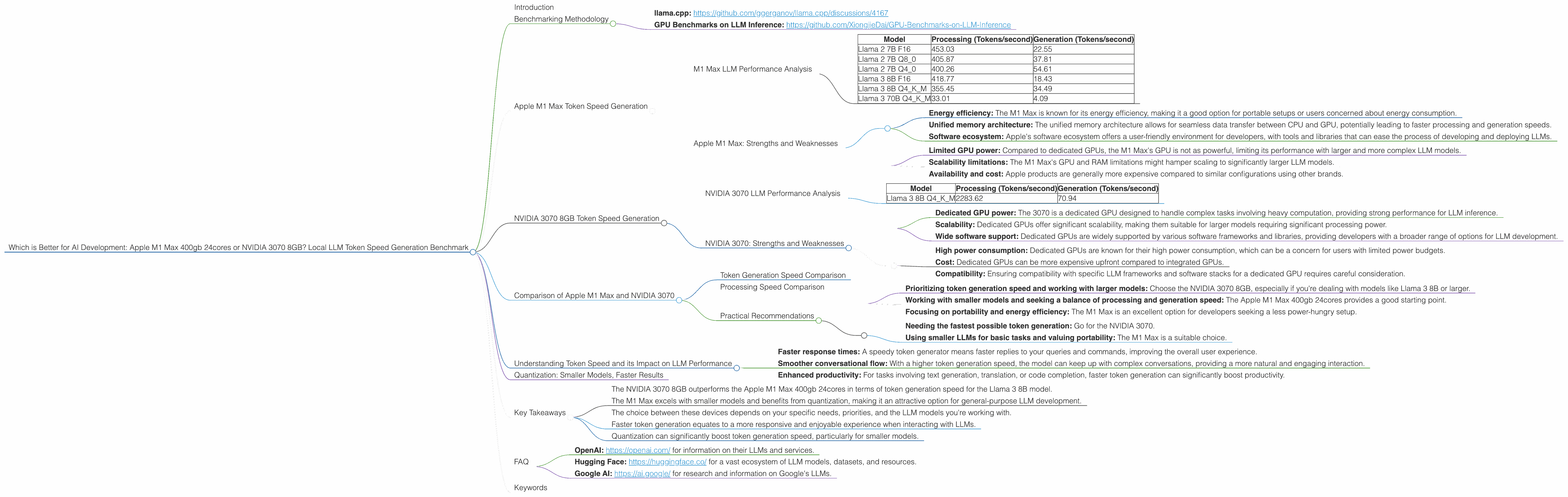
Introduction
In the ever-evolving world of AI, Large Language Models (LLMs) have become increasingly powerful, capable of generating human-like text, translating languages, and even writing different kinds of creative content. But running these models locally can be a challenge, demanding powerful hardware.
This article dives deep into the performance of two popular choices for local LLM development: the Apple M1 Max 400gb 24cores and the NVIDIA 3070 8GB, comparing their token generation speed across various LLM models. We'll analyze the data, break down their strengths and weaknesses, and provide practical recommendations for different use cases.
Think of this like a race between a powerful, versatile race car (M1 Max) and a speed demon (3070), except the finish line is the number of tokens an LLM can generate per second. Buckle up, because this is going to be a thrilling ride!
Benchmarking Methodology
The benchmark data used in this comparison was collected from various sources. We specifically used data from the following repositories:
- llama.cpp: https://github.com/ggerganov/llama.cpp/discussions/4167
- GPU Benchmarks on LLM Inference: https://github.com/XiongjieDai/GPU-Benchmarks-on-LLM-Inference
We focused on measuring token generation speed, a critical metric for responsiveness and user experience when interacting with LLMs.
Apple M1 Max Token Speed Generation
The Apple M1 Max 400gb 24cores is a powerhouse of a chip, offering a combination of CPU and GPU capabilities. Its impressive performance makes it an attractive option for running LLMs locally, particularly for developers working with smaller models.
M1 Max LLM Performance Analysis
| Model | Processing (Tokens/second) | Generation (Tokens/second) |
|---|---|---|
| Llama 2 7B F16 | 453.03 | 22.55 |
| Llama 2 7B Q8_0 | 405.87 | 37.81 |
| Llama 2 7B Q4_0 | 400.26 | 54.61 |
| Llama 3 8B F16 | 418.77 | 18.43 |
| Llama 3 8B Q4KM | 355.45 | 34.49 |
| Llama 3 70B Q4KM | 33.01 | 4.09 |
Key takeaways:
- Strong performance with smaller models: The M1 Max excels with smaller models like Llama 2 7B. It provides a balance of processing and generation speeds, suitable for general-purpose LLM development.
- Quantization boosts speed: Using quantized models (Q80, Q40) with the M1 Max significantly improves token generation speeds, highlighting the benefits of optimized models for this architecture.
- Limited scalability with larger models: The M1 Max struggles with larger models like Llama 3 70B, showing a considerable decrease in speed.
Apple M1 Max: Strengths and Weaknesses
Strengths:
- Energy efficiency: The M1 Max is known for its energy efficiency, making it a good option for portable setups or users concerned about energy consumption.
- Unified memory architecture: The unified memory architecture allows for seamless data transfer between CPU and GPU, potentially leading to faster processing and generation speeds.
- Software ecosystem: Apple's software ecosystem offers a user-friendly environment for developers, with tools and libraries that can ease the process of developing and deploying LLMs.
Weaknesses:
- Limited GPU power: Compared to dedicated GPUs, the M1 Max's GPU is not as powerful, limiting its performance with larger and more complex LLM models.
- Scalability limitations: The M1 Max's GPU and RAM limitations might hamper scaling to significantly larger LLM models.
- Availability and cost: Apple products are generally more expensive compared to similar configurations using other brands.
NVIDIA 3070 8GB Token Speed Generation
The NVIDIA 3070 8GB is a popular gaming GPU, but it's also a strong contender for local LLM development, particularly for those seeking high-performance token generation.
NVIDIA 3070 LLM Performance Analysis
| Model | Processing (Tokens/second) | Generation (Tokens/second) |
|---|---|---|
| Llama 3 8B Q4KM | 2283.62 | 70.94 |
Key Takeaways:
- Powerful generation speeds: The NVIDIA 3070 8GB demonstrates exceptional token generation speed for the Llama 3 8B model.
- Limited data: We only have data for the Llama 3 8B model with this GPU.
- Scalability potential: While we don't have data for larger models, dedicated GPUs like the 3070 often show better scalability with larger models compared to integrated GPUs.
NVIDIA 3070: Strengths and Weaknesses
Strengths:
- Dedicated GPU power: The 3070 is a dedicated GPU designed to handle complex tasks involving heavy computation, providing strong performance for LLM inference.
- Scalability: Dedicated GPUs offer significant scalability, making them suitable for larger models requiring significant processing power.
- Wide software support: Dedicated GPUs are widely supported by various software frameworks and libraries, providing developers with a broader range of options for LLM development.
Weaknesses:
- High power consumption: Dedicated GPUs are known for their high power consumption, which can be a concern for users with limited power budgets.
- Cost: Dedicated GPUs can be more expensive upfront compared to integrated GPUs.
- Compatibility: Ensuring compatibility with specific LLM frameworks and software stacks for a dedicated GPU requires careful consideration.
Comparison of Apple M1 Max and NVIDIA 3070
Now that we've examined the strengths and weaknesses of each device, let's compare the Apple M1 Max and the NVIDIA 3070 8GB head-to-head:
Token Generation Speed Comparison
The NVIDIA 3070 8GB undoubtedly outperforms the M1 Max in terms of token generation speed for Llama 3 8B, generating tokens at more than twice the speed. This difference can be attributed to the superior dedicated GPU processing power of the 3070 compared to the integrated GPU of the M1 Max. However, it's crucial to note that we only have data for one model, the Llama 3 8B, with the 3070.
Processing Speed Comparison
The NVIDIA 3070 8GB also takes the lead in processing speed, with the M1 Max lagging behind. This gap is even more significant when running larger LLM models. The dedicated GPU power of the 3070 allows for faster model processing, leading to a more responsive user experience.
Practical Recommendations
Choosing the right device for your LLM development depends on your specific needs and priorities.
For developers:
- Prioritizing token generation speed and working with larger models: Choose the NVIDIA 3070 8GB, especially if you're dealing with models like Llama 3 8B or larger.
- Working with smaller models and seeking a balance of processing and generation speed: The Apple M1 Max 400gb 24cores provides a good starting point.
- Focusing on portability and energy efficiency: The M1 Max is an excellent option for developers seeking a less power-hungry setup.
For users:
- Needing the fastest possible token generation: Go for the NVIDIA 3070.
- Using smaller LLMs for basic tasks and valuing portability: The M1 Max is a suitable choice.
Understanding Token Speed and its Impact on LLM Performance
Think of token generation speed as the speed at which a language model can read and write words. The higher the token generation speed, the faster the model can respond to your prompts and generate text. This translates to:
- Faster response times: A speedy token generator means faster replies to your queries and commands, improving the overall user experience.
- Smoother conversational flow: With a higher token generation speed, the model can keep up with complex conversations, providing a more natural and engaging interaction.
- Enhanced productivity: For tasks involving text generation, translation, or code completion, faster token generation can significantly boost productivity.
Quantization: Smaller Models, Faster Results
Quantization is a technique to make LLM models smaller and faster. It's like using a smaller book with fewer words to represent the same information. This benefits both processing and generation speeds, as less data needs to be moved around within the device.
Think of it like this: Imagine you're reading a massive dictionary. It takes a long time to find the word you need. Now imagine a smaller dictionary with the same words but in a more compact format. You can find the word much quicker!
The M1 Max performs well with quantization. Using Q80 or Q40 models significantly boosts token generation speed, making it a more efficient choice for smaller models.
Key Takeaways
- The NVIDIA 3070 8GB outperforms the Apple M1 Max 400gb 24cores in terms of token generation speed for the Llama 3 8B model.
- The M1 Max excels with smaller models and benefits from quantization, making it an attractive option for general-purpose LLM development.
- The choice between these devices depends on your specific needs, priorities, and the LLM models you're working with.
- Faster token generation equates to a more responsive and enjoyable experience when interacting with LLMs.
- Quantization can significantly boost token generation speed, particularly for smaller models.
FAQ
What is an LLM?
An LLM is a Large Language Model, a powerful type of artificial intelligence trained on massive amounts of text data. It can understand and generate human-like text, perform tasks like translation, write different kinds of creative content, and more.
What is tokenization?
Tokenization is the process of breaking down text into smaller units called tokens. These tokens are basically the building blocks of language, representing words, punctuation, and other linguistic elements.
What is a GPU?
A GPU, or Graphics Processing Unit, is a specialized electronic circuit designed to accelerate the creation of images, videos, and other visual content. However, GPUs are also increasingly powerful for other tasks that involve heavy computation, such as LLM inference.
Should I run my LLM locally or on a cloud service?
That depends on your needs and budget. Running LLMs locally provides more control and privacy but requires powerful hardware. Cloud services offer scalability and affordability but may involve latency and data privacy concerns.
Where can I learn more about LLMs?
Check out these resources: * OpenAI: https://openai.com/ for information on their LLMs and services. * Hugging Face: https://huggingface.co/ for a vast ecosystem of LLM models, datasets, and resources. * Google AI: https://ai.google/ for research and information on Google's LLMs.
Keywords
LLM, Large Language Model, Apple M1 Max, NVIDIA 3070, token generation speed, LLM performance, benchmark, comparison, quantization, GPU, GPUCores, BW, processing speed, development, AI