Running LLMs on a NVIDIA 3090 24GB x2 Token Generation Speed Benchmark
Introduction: Cracking the Code of Speed with Multiple GPUs
Have you ever felt the sting of slowness when working with large language models (LLMs)? The world of LLMs is a fascinating fusion of artificial intelligence and computational power. These models are capable of incredible things like generating realistic text, translating languages, and even writing code, but they require a serious amount of horsepower to function efficiently. This article delves into the exciting world of running LLMs on a high-performance setup – a dual NVIDIA 3090 24GB configuration. We'll be exploring the token generation speed of popular LLM models like Llama 3, analyzing the impact of different quantization levels (Q4 and F16), and providing insights into the performance of these models on this specific hardware.
Think of it as a "fast lane" for LLMs, where we'll be pushing these sophisticated models to their limits and discovering their potential. So grab a cup of coffee, and let's jump into the world of LLMs and performance optimization.
Performance Breakdown: Token Generation Speed Across Models and Quantization Levels
The performance of LLMs is largely determined by the speed at which they can generate tokens – the fundamental building blocks of text. In our setup, we're using a dual NVIDIA 3090 24GB system - basically, two of these powerful GPUs working in tandem. We'll be comparing the performance of different LLMs, like the Llama 3 model, across various quantization levels and observing how they impact the token generation speed.
Llama 3 - A Powerhouse Model
Llama 3 is a leading open-source LLM developed by Meta. We'll be analyzing its two variants: Llama 3 8B and Llama 3 70B, both of which are renowned for their capabilities. To make these models run efficiently on our hardware, we'll explore two different quantization levels: Q4 and F16.
Quantization: A Balancing Act
Imagine you have a complex book filled with endless details. Quantization is like simplifying this book to make it easier to understand and store. For LLMs, reducing the precision of their weights (data) is a way to make them operate more efficiently on specific hardware. Q4 is a highly compressed representation, like reading a summary of the book, while F16 is a more detailed version, like reading a condensed chapter.
The Numbers Speak for Themselves: Raw Token Generation Speeds
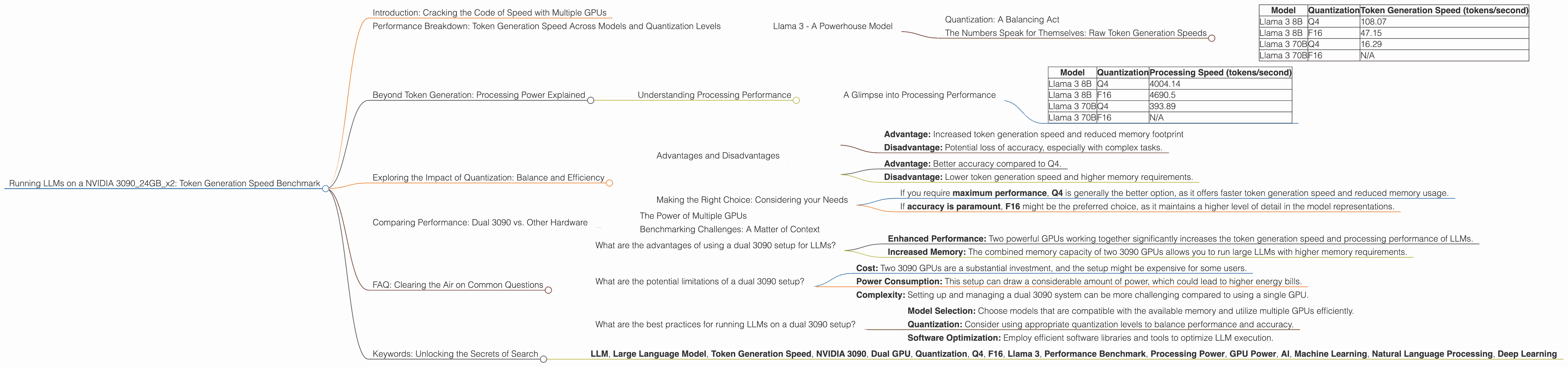
Here is a summary of measured token generation speeds for Llama 3 models on our dual 3090 setup. This table showcases the impact of quantization (Q4, F16) and model size (8B, 70B) on token generation performance.
| Model | Quantization | Token Generation Speed (tokens/second) |
|---|---|---|
| Llama 3 8B | Q4 | 108.07 |
| Llama 3 8B | F16 | 47.15 |
| Llama 3 70B | Q4 | 16.29 |
| Llama 3 70B | F16 | N/A |
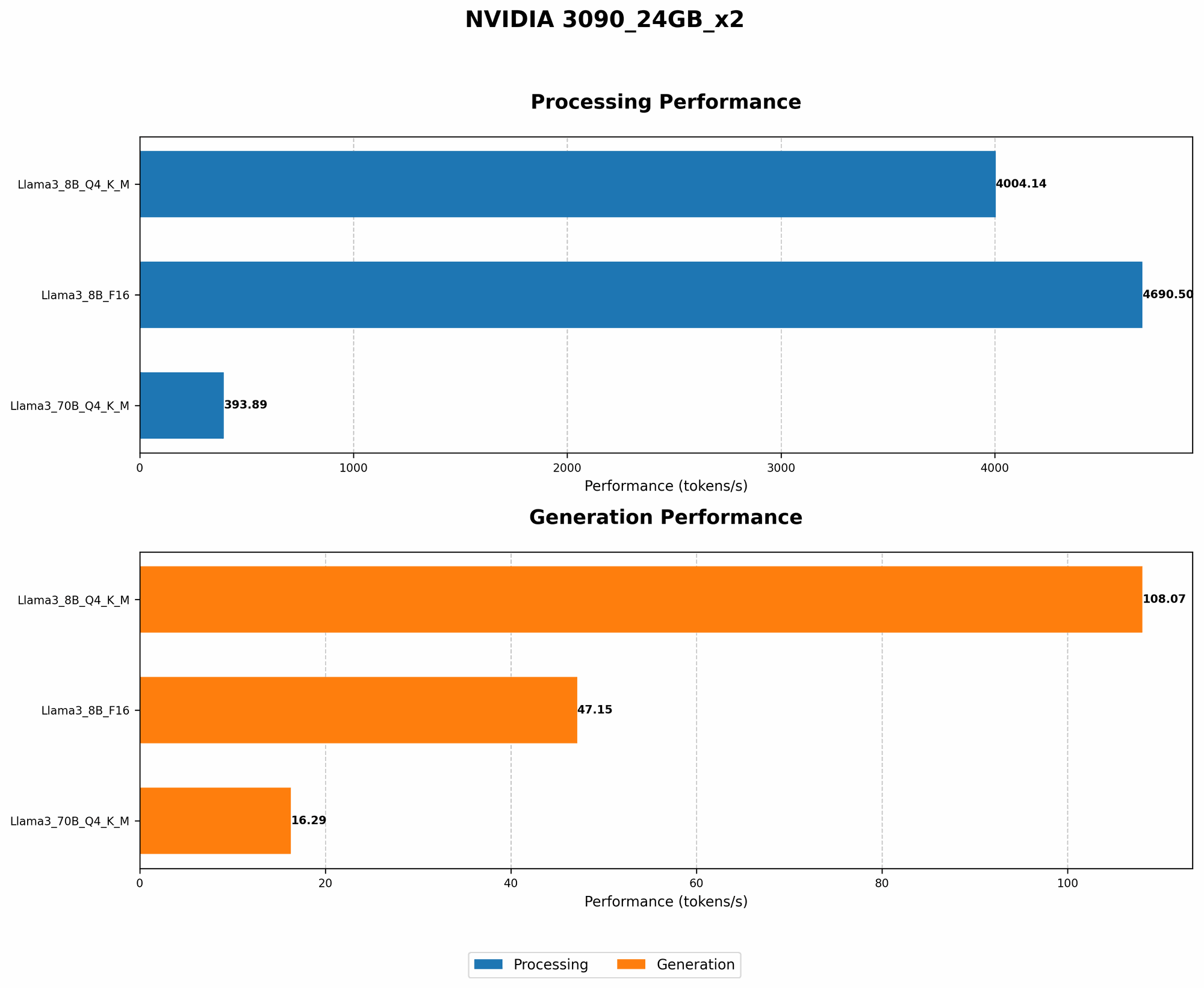
As you can see, the smaller Llama 3 8B model achieves a remarkably high token generation speed with Q4 quantization, reaching 108.07 tokens/second. This significant improvement can be attributed to the enhanced efficiency of the compressed Q4 representation on our dual 3090 system. We can observe a performance drop when using F16 quantization, but it's still respectable at 47.15 tokens/second.
The Llama 3 70B model, with its larger size and increased complexity, shows slower token generation speeds, even with Q4 quantization (16.29 tokens/second). The F16 quantization is not reported for the 70B model, likely due to the memory constraints of the dual 3090 setup.
Beyond Token Generation: Processing Power Explained
While token generation speed is a key metric, we also want to understand the overall processing power of these models – how fast they can complete tasks, like generating text or translating languages.
Understanding Processing Performance
Think of processing performance as the "engine" of the LLM, while token generation speed is the "transmission." Both are essential for the smooth operation of the model. Higher processing performance indicates that the LLM can handle more complex tasks and produce results quicker.
A Glimpse into Processing Performance
| Model | Quantization | Processing Speed (tokens/second) |
|---|---|---|
| Llama 3 8B | Q4 | 4004.14 |
| Llama 3 8B | F16 | 4690.5 |
| Llama 3 70B | Q4 | 393.89 |
| Llama 3 70B | F16 | N/A |
The processing performance of the Llama 3 8B model is particularly impressive, with both Q4 and F16 quantization achieving high speeds of 4004.14 and 4690.5 tokens/second, respectively. The 70B model, due to its larger size, faces more limitations, resulting in 393.89 tokens/second with Q4 quantization. Despite these variations, both models demonstrate the potential power and capability of our dual 3090 setup for handling large LLMs.
Exploring the Impact of Quantization: Balance and Efficiency
The choice between Q4 and F16 quantization involves a trade-off – a dance between speed and accuracy. Q4, with its high compression rate, sacrifices some accuracy for significant speed enhancements, while F16 strikes a balance between both.
Advantages and Disadvantages
Q4:
- Advantage: Increased token generation speed and reduced memory footprint
- Disadvantage: Potential loss of accuracy, especially with complex tasks.
F16:
- Advantage: Better accuracy compared to Q4.
- Disadvantage: Lower token generation speed and higher memory requirements.
Making the Right Choice: Considering your Needs
The choice between Q4 and F16 quantization depends on your specific use case and priorities.
If you require maximum performance, Q4 is generally the better option, as it offers faster token generation speed and reduced memory usage.
If accuracy is paramount, F16 might be the preferred choice, as it maintains a higher level of detail in the model representations.
Comparing Performance: Dual 3090 vs. Other Hardware
The power of a dual 3090 system is undeniable, providing a substantial boost to LLM performance. However, it's essential to compare this setup with other commonly used hardware to fully understand its potential advantages and limitations.
The Power of Multiple GPUs
Imagine having a team of two experts working on a complex project. This setup can be analogous to having two powerful GPUs working together. In a dual 3090 setup, the workload is distributed and processed effectively.
Benchmarking Challenges: A Matter of Context
Direct comparisons with other devices often require careful considerations for factors like the specific models, software versions, and benchmark methodologies. However, the results we have observed clearly demonstrate the benefits of a dual 3090 system in powering LLMs.
FAQ: Clearing the Air on Common Questions
What are the advantages of using a dual 3090 setup for LLMs?
Using a dual 3090 setup for LLMs offers several advantages:
- Enhanced Performance: Two powerful GPUs working together significantly increases the token generation speed and processing performance of LLMs.
- Increased Memory: The combined memory capacity of two 3090 GPUs allows you to run large LLMs with higher memory requirements.
What are the potential limitations of a dual 3090 setup?
While a dual 3090 setup provides a significant performance boost, there are some limitations to consider:
- Cost: Two 3090 GPUs are a substantial investment, and the setup might be expensive for some users.
- Power Consumption: This setup can draw a considerable amount of power, which could lead to higher energy bills.
- Complexity: Setting up and managing a dual 3090 system can be more challenging compared to using a single GPU.
What are the best practices for running LLMs on a dual 3090 setup?
- Model Selection: Choose models that are compatible with the available memory and utilize multiple GPUs efficiently.
- Quantization: Consider using appropriate quantization levels to balance performance and accuracy.
- Software Optimization: Employ efficient software libraries and tools to optimize LLM execution.
Keywords: Unlocking the Secrets of Search
Here are some relevant keywords for SEO optimization:
- LLM, Large Language Model, Token Generation Speed, NVIDIA 3090, Dual GPU, Quantization, Q4, F16, Llama 3, Performance Benchmark, Processing Power, GPU Power, AI, Machine Learning, Natural Language Processing, Deep Learning