Running LLMs on a NVIDIA 3080 10GB Token Generation Speed Benchmark

Introduction
The world of large language models (LLMs) is exploding, with new models being released seemingly every day. These models can generate text, translate languages, write different kinds of creative content, and answer your questions in an informative way, but running them locally can be a real challenge! Today, we're diving into the world of LLMs and focusing on the NVIDIA GeForce RTX 3080 10GB, a popular graphics card for gamers and AI enthusiasts. We'll see how well it performs when tasked with generating tokens, the building blocks of text, for various LLMs.
The NVIDIA 3080 10GB: A Beastly Graphics Card for LLMs
The NVIDIA GeForce RTX 3080 10GB is a powerful graphics card known for its gaming prowess, but it's also a solid choice for running LLMs. With its Ampere architecture and generous 10GB of GDDR6X memory, it can handle the demanding computations involved in processing and generating text. But how does it specifically stack up for LLMs?
Benchmarking Token Generation Speed
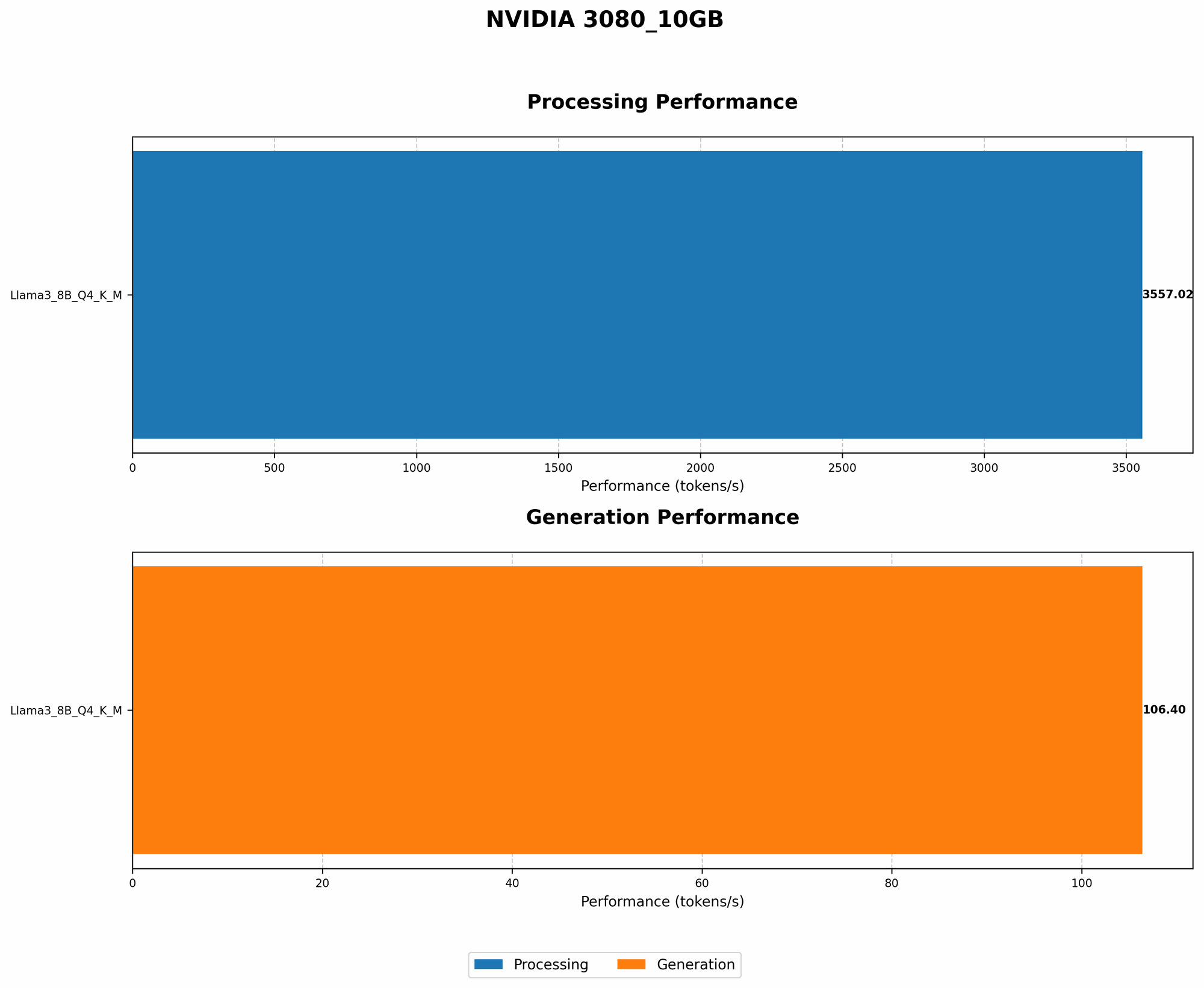
To get a clear picture of the NVIDIA 3080 10GB's performance, we'll be looking at the token generation speed for various popular LLMs. Our data comes from two excellent sources:
- ggerganov's llama.cpp benchmark: This benchmark tests the performance of the Llama.cpp library, which is a popular tool for running LLMs locally. (https://github.com/ggerganov/llama.cpp/discussions/4167)
- XiongjieDai's GPU Benchmarks on LLM Inference: This benchmark focuses on evaluating the performance of various GPU models for LLM inference. (https://github.com/XiongjieDai/GPU-Benchmarks-on-LLM-Inference)
Understanding Token Generation
Let's break down what we mean by "token generation speed." Think of tokens as the smallest meaningful units of text. They can be words, parts of words, or even punctuation marks. For example, the sentence, "The cat sat on the mat," would break down into the following tokens: "The", "cat", "sat", "on", "the", "mat."
Token generation speed measures how quickly an LLM on a specific GPU can generate tokens. The higher the speed, the faster the model can produce text.
Benchmarking Results: Llama 3 8B Q4KM
Let's begin with the Llama 3 8B Q4KM model. This model is a quantized version of the larger Llama 3 8B, which involves using fewer bits to represent the weights of the model. This quantization makes the model smaller and faster, but it can slightly impact accuracy.
| Model | NVIDIA 3080 10GB | |
|---|---|---|
| Llama 3 8B Q4KM | 106.4 tokens/second | Generation Speed |
| Llama 3 8B Q4KM | 3557.02 tokens/second | Processing Speed |
We can see that the NVIDIA 3080 10GB can generate around 106.4 tokens per second for the Llama 3 8B Q4KM model.
Discussion: The NVIDIA 3080 10GB: A Decent Choice for Llamas
This speed isn't mind-blowing, especially considering the 3080's power. For comparison, you might find that a high-end consumer CPU can achieve about 10-15 tokens/second for the same model. The 3080 is still noticeably faster, but we can't quite consider this result a "breakthrough."
The fact that the 3080 10GB doesn't seem to provide a significant advantage over a high-end CPU highlights the importance of GPU architecture and optimization for efficient LLM processing. These advancements are constantly being made.
Llama 3 8B F16: Missing Data, But What Could it Mean?
Unfortunately, we don't have data for the Llama 3 8B F16 model. This model uses 16-bit floating-point numbers for its weights instead of quantization. The F16 model is often slightly slower than the quantized version, but it might be more accurate in some tasks.
The lack of data doesn't necessarily mean that the 3080 10GB is bad at running the F16 model, but it does highlight the need for more comprehensive benchmarking. There are many factors that can influence LLM performance.
Llama 3 70B: Why We Can't Run These Models Locally (Yet)
The benchmark data doesn't include results for the Llama 3 70B model on the NVIDIA 3080 10GB. We'll see why the 3080 is likely struggling here.
- Memory Capacity: The Llama 3 70B model is much larger than the 8B model. It requires a significant amount of memory to store its parameters. The 3080 10GB might simply not have enough memory to load the entire model.
- Compute Power: While the 3080 is a powerful card for gaming, its processing capabilities might not be sufficient for efficiently handling a model as large as the Llama 3 70B.
This doesn't mean you need a new GPU just yet. The landscape for running LLMs locally is rapidly evolving.
A Look Beyond the 3080 10GB: What About Other GPUs?
It's easy to focus on the 3080, but keep in mind that the world of GPUs is vast and evolving! There are GPUs designed specifically for AI workloads. We can't go too deep into this here, but it's worth understanding these concepts for future LLM exploration.
NVIDIA's A100: The AI Workhorse
For serious AI applications, the NVIDIA A100 is a top contender. It's designed specifically for AI and deep learning applications. It boasts massive memory capacity and processing power, making it ideal for running large LLMs.
The Rise of Specialized Hardware
Companies like Google and Cerebras are developing specialized hardware for AI, focusing on efficiency and speed. This hardware might be the future of local LLM processing, though they might not be readily accessible to individual users.
FAQ: Your LLM-Related Questions Answered
Here are some common questions about LLMs and NVIDIA's GPUs:
Q: What are LLMs?
A: LLMs are advanced AI models that are trained on a massive amount of text data. They can generate text, translate languages, write different kinds of creative content, and answer your questions in an informative way.
Q: Why are LLMs getting so popular?
A: LLMs are becoming widely adopted because they have the potential to revolutionize many industries. They can automate tasks, generate new ideas, and improve human efficiency.
Q: Do I need a high-end GPU to run LLMs?
A: Not necessarily! You can run some smaller LLMs on good CPUs. But if you want to run larger models, a high-end GPU can provide significant performance gains.
Q: What's the best GPU for running LLMs?
A: The best GPU depends on the specific LLM you want to run and your budget. For smaller models, a high-end consumer GPU like the 3080 10GB can work well. For larger models, specialized GPUs like the NVIDIA A100 or Google's TPU are more suitable.
Q: How do I choose the right GPU for LLMs?
A: Consider the following factors:
- Memory capacity: LLMs require a lot of memory to store their parameters. Choose a GPU with sufficient memory.
- Compute power: LLMs demand high processing power. Select a GPU with a high number of CUDA cores or Tensor cores.
- Power consumption: GPUs can draw a significant amount of power. Make sure your power supply can handle the load.
Q: What's the future of LLMs?
A: The future of LLMs is bright and exciting. We can expect to see even more powerful models with increased capabilities. New hardware specifically designed for LLMs will continue to emerge.
Keywords:
LLMs, NVIDIA 3080 10GB, Token generation speed, GPU, Llama 3, Llama 3 8B, Llama 3 70B, Q4KM, F16, AI, benchmark, performance, processing, generation, memory capacity, A100, TPU, specialized hardware, speed, efficiency.