NVIDIA 3090 24GB vs. NVIDIA RTX 6000 Ada 48GB for LLMs: Which is Faster in Token Generation Speed? Benchmark Analysis
Introduction
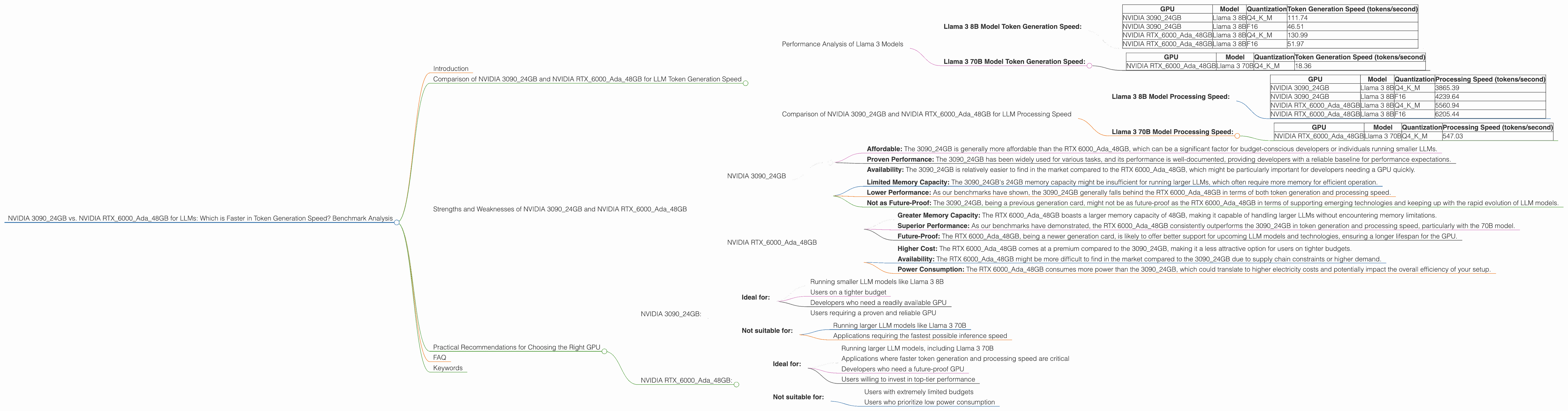
The world of large language models (LLMs) is booming, and with it comes a growing need for powerful hardware to handle the immense computational demands. Two popular graphics processing units (GPUs) often considered for running LLMs are the NVIDIA GeForce RTX 3090 with 24GB of memory and the NVIDIA RTX 6000 Ada with 48GB of memory.
Imagine you're training a large language model like a giant, intelligent parrot. This parrot needs to learn how to speak and understand human language, which is a lot of data to process. To speed up the process, you need a powerful computer with a super-fast brain, like a GPU. The NVIDIA GeForce RTX 3090 and NVIDIA RTX 6000 Ada are like two different super-powerful brains, each with its strengths and weaknesses.
This article compares the token generation speed of these two GPUs when running popular LLM models, mainly focusing on the Llama 3 family. We'll dive into the benchmark results, analyze their performance, and provide practical recommendations for choosing the right GPU based on your specific needs.
Comparison of NVIDIA 309024GB and NVIDIA RTX6000Ada48GB for LLM Token Generation Speed
Performance Analysis of Llama 3 Models
This section focuses on the performance of the NVIDIA 309024GB and NVIDIA RTX6000Ada48GB GPUs when used to run Llama 3 LLM models. We'll examine their token generation speed for various model sizes and quantization levels.
Llama 3 8B Model Token Generation Speed:
| GPU | Model | Quantization | Token Generation Speed (tokens/second) |
|---|---|---|---|
| NVIDIA 3090_24GB | Llama 3 8B | Q4KM | 111.74 |
| NVIDIA 3090_24GB | Llama 3 8B | F16 | 46.51 |
| NVIDIA RTX6000Ada_48GB | Llama 3 8B | Q4KM | 130.99 |
| NVIDIA RTX6000Ada_48GB | Llama 3 8B | F16 | 51.97 |
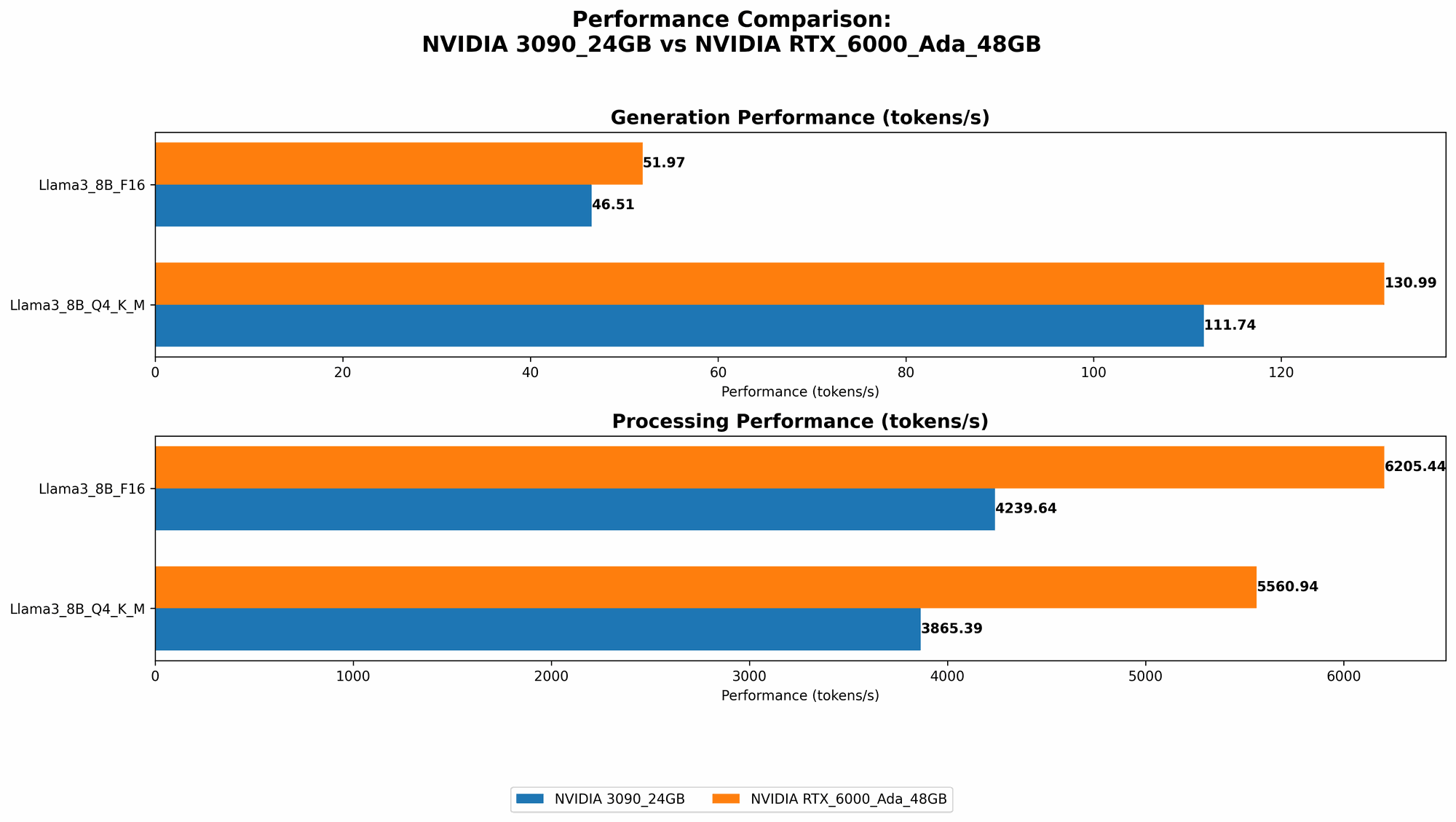
The RTX 6000Ada48GB outperforms the 309024GB in terms of token generation speed for both Q4KM and F16 quantization levels. It is about 17% faster for Q4KM and 12% faster for F16 quantization. This makes the RTX 6000Ada_48GB a better choice for applications where faster token generation is critical.
Key Takeaways:
- RTX 6000Ada48GB is faster: The RTX 6000Ada48GB consistently outperforms the 3090_24GB in token generation speed for the Llama 3 8B model.
- Quantization impacts performance: We observe a significant performance difference between Q4KM and F16 quantization levels, with Q4KM significantly faster.
- Consider your need for speed: If you need the fastest possible token generation speed, the RTX 6000Ada48GB is the clear winner.
Llama 3 70B Model Token Generation Speed:
| GPU | Model | Quantization | Token Generation Speed (tokens/second) |
|---|---|---|---|
| NVIDIA RTX6000Ada_48GB | Llama 3 70B | Q4KM | 18.36 |
- Limited Data: There is no data for the 309024GB with the Llama 3 70B model, nor for the F16 quantization level of the RTX 6000Ada_48GB.
Despite limited data, the RTX 6000Ada48GB demonstrates its ability to handle larger models like the Llama 3 70B. It's important to note that the token generation speed is significantly lower for the 70B model compared to the 8B model, highlighting the increased computational demands of larger models.
Key Takeaways:
- Larger models require more resources: The token generation speed for the 70B model is much slower than for the 8B model, indicating that larger models inherently demand more computational resources.
- RTX 6000Ada48GB can handle larger models: The RTX 6000Ada48GB has the capacity to run larger models like the Llama 3 70B.
- More data needed: Further benchmarking is needed for a complete comparison between the two GPUs for the 70B model, especially with F16 quantization.
Comparison of NVIDIA 309024GB and NVIDIA RTX6000Ada48GB for LLM Processing Speed
This section analyzes the processing speed of the NVIDIA 309024GB and NVIDIA RTX6000Ada48GB GPUs for LLM models. Processing speed refers to the overall efficiency of the GPU in handling the computational tasks involved in running an LLM, including token generation, attention calculations, and other operations.
Llama 3 8B Model Processing Speed:
| GPU | Model | Quantization | Processing Speed (tokens/second) |
|---|---|---|---|
| NVIDIA 3090_24GB | Llama 3 8B | Q4KM | 3865.39 |
| NVIDIA 3090_24GB | Llama 3 8B | F16 | 4239.64 |
| NVIDIA RTX6000Ada_48GB | Llama 3 8B | Q4KM | 5560.94 |
| NVIDIA RTX6000Ada_48GB | Llama 3 8B | F16 | 6205.44 |
Similar to token generation speed, the RTX 6000Ada48GB outperforms the 309024GB in terms of processing speed. Both GPUs show a slight improvement in processing speed when using F16 quantization compared to Q4K_M quantization.
Key Takeaways:
- RTX 6000Ada48GB delivers better processing: The RTX 6000Ada48GB shows significantly faster processing speed for the Llama 3 8B model compared to the 3090_24GB.
- F16 quantization for better processing: Using F16 quantization for the Llama 3 8B model slightly improves processing speed for both GPUs, but the RTX 6000Ada48GB still offers a considerable performance advantage.
- Faster processing for faster results: The RTX 6000Ada48GB's faster processing time translates to quicker inference and overall better performance when running LLM models.
Llama 3 70B Model Processing Speed:
| GPU | Model | Quantization | Processing Speed (tokens/second) |
|---|---|---|---|
| NVIDIA RTX6000Ada_48GB | Llama 3 70B | Q4KM | 547.03 |
- Limited Data: Similar to token generation speed, no data is available for the 309024GB with the Llama 3 70B model, and no data for the F16 quantization level of the RTX 6000Ada_48GB.
Again, despite limited data, the RTX 6000Ada48GB showcases its ability to handle larger models. The significant drop in processing speed compared to the 8B model is a clear indication of the increased computational demands of running larger models like the 70B model.
Key Takeaways:
- Larger models = slower processing: Running larger models like Llama 3 70B significantly reduces processing speed compared to smaller models.
- RTX 6000Ada48GB for large models: The RTX 6000Ada48GB demonstrated its competency in handling large models like the Llama 3 70B, although further benchmarking is needed.
- More data required: More data is needed for a comprehensive comparison, particularly with F16 quantization for the RTX 6000Ada48GB.
Strengths and Weaknesses of NVIDIA 309024GB and NVIDIA RTX6000Ada48GB
Now that we've analyzed their performance, let's delve into the key strengths and weaknesses of each GPU.
NVIDIA 3090_24GB
Strengths:
- Affordable: The 309024GB is generally more affordable than the RTX 6000Ada_48GB, which can be a significant factor for budget-conscious developers or individuals running smaller LLMs.
- Proven Performance: The 3090_24GB has been widely used for various tasks, and its performance is well-documented, providing developers with a reliable baseline for performance expectations.
- Availability: The 309024GB is relatively easier to find in the market compared to the RTX 6000Ada_48GB, which might be particularly important for developers needing a GPU quickly.
Weaknesses:
- Limited Memory Capacity: The 3090_24GB's 24GB memory capacity might be insufficient for running larger LLMs, which often require more memory for efficient operation.
- Lower Performance: As our benchmarks have shown, the 309024GB generally falls behind the RTX 6000Ada_48GB in terms of both token generation and processing speed.
- Not as Future-Proof: The 309024GB, being a previous generation card, might not be as future-proof as the RTX 6000Ada_48GB in terms of supporting emerging technologies and keeping up with the rapid evolution of LLM models.
NVIDIA RTX6000Ada_48GB
Strengths:
- Greater Memory Capacity: The RTX 6000Ada48GB boasts a larger memory capacity of 48GB, making it capable of handling larger LLMs without encountering memory limitations.
- Superior Performance: As our benchmarks have demonstrated, the RTX 6000Ada48GB consistently outperforms the 3090_24GB in token generation and processing speed, particularly with the 70B model.
- Future-Proof: The RTX 6000Ada48GB, being a newer generation card, is likely to offer better support for upcoming LLM models and technologies, ensuring a longer lifespan for the GPU.
Weaknesses:
- Higher Cost: The RTX 6000Ada48GB comes at a premium compared to the 3090_24GB, making it a less attractive option for users on tighter budgets.
- Availability: The RTX 6000Ada48GB might be more difficult to find in the market compared to the 3090_24GB due to supply chain constraints or higher demand.
- Power Consumption: The RTX 6000Ada48GB consumes more power than the 3090_24GB, which could translate to higher electricity costs and potentially impact the overall efficiency of your setup.
Practical Recommendations for Choosing the Right GPU
The choice between the NVIDIA 309024GB and NVIDIA RTX6000Ada48GB for running LLMs ultimately depends on your specific needs, budget, and project requirements.
NVIDIA 3090_24GB:
- Ideal for:
- Running smaller LLM models like Llama 3 8B
- Users on a tighter budget
- Developers who need a readily available GPU
- Users requiring a proven and reliable GPU
- Not suitable for:
- Running larger LLM models like Llama 3 70B
- Applications requiring the fastest possible inference speed
NVIDIA RTX6000Ada_48GB:
- Ideal for:
- Running larger LLM models, including Llama 3 70B
- Applications where faster token generation and processing speed are critical
- Developers who need a future-proof GPU
- Users willing to invest in top-tier performance
- Not suitable for:
- Users with extremely limited budgets
- Users who prioritize low power consumption
FAQ
Q: How to choose the right GPU for running LLM models?
A: Consider factors such as your model size, budget, performance requirements, and future-proofing. For smaller models, the 309024GB might be sufficient. For larger models or applications demanding high speed, the RTX 6000Ada_48GB is a better choice.
Q: What's the difference between Q4KM and F16 quantization?
A: Quantization is a technique to reduce the size of a large language model by representing its weights using fewer bits, which can improve memory efficiency and speed up inference. Q4KM uses 4 bits for the weights and 4 bits for the activation, while F16 uses 16 bits for the activation. Q4KM often offers faster performance but may have a slight accuracy drop, while F16 maintains higher accuracy but might be slightly slower.
Q: What does "token generation speed" mean?
A: Token generation speed measures how fast a GPU can process text and generate new words or phrases. It is measured in units of tokens per second.
Q: Why are larger LLMs slower to run?
A: Larger LLMs have more complex internal representations and require more computations to process text. This leads to increased resource demands, resulting in slower token generation and processing speeds.
Keywords
NVIDIA 309024GB, NVIDIA RTX6000Ada48GB, LLM, large language model, token generation speed, GPU, benchmark, Llama 3, 8B, 70B, Q4KM, F16, quantization, processing speed, performance, recommendation, strengths, weaknesses, inference, budget, efficiency, power consumption, future-proof,