How Fast Can Apple M3 Max Run Llama2 7B?

Introduction
The world of large language models (LLMs) is ablaze with excitement. These powerful AI models can generate human-like text, translate languages, write different kinds of creative content, and answer your questions in an informative way. But the sheer size of LLMs, with billions of parameters, presents challenges in terms of processing power and storage.
This article will dive deep into the performance of Apple's M3_Max chip running the Llama2 7B model, analyzing its token generation speed across different quantization levels. We'll break down the data, compare performance with other devices and models, and provide practical recommendations for developers. Buckle up for a geeky ride!
Performance Analysis: Token Generation Speed Benchmarks - Apple M1 Max and Llama2 7B
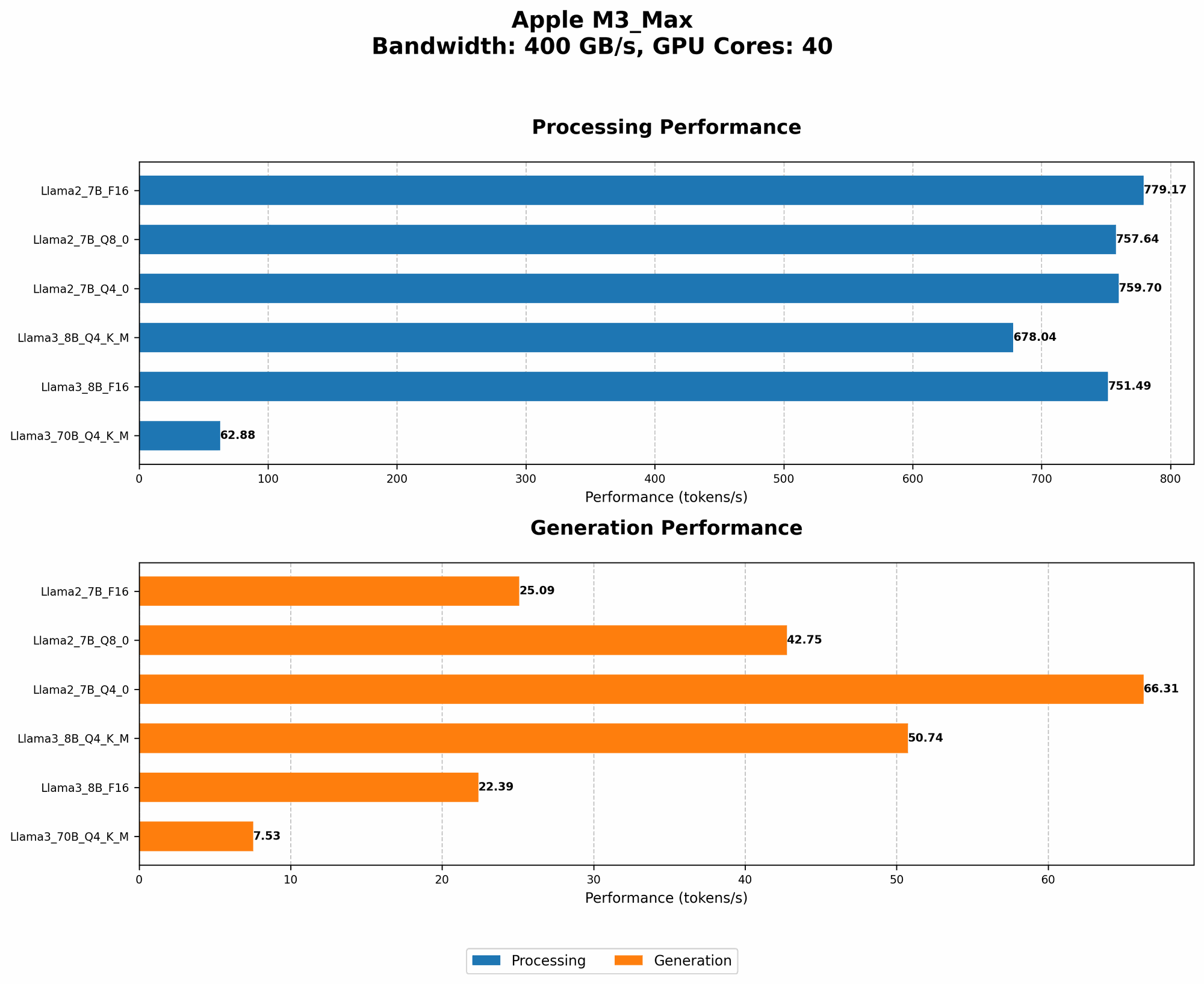
Let's get our hands dirty with the numbers! The following table shows the token generation speed of Llama2 7B on the Apple M3_Max chip at various quantization levels.
Quantization is a technique used to reduce the size and computational demands of LLMs by converting large numbers (like 32-bit floating-point numbers) into smaller ones (like 16-bit or even 8-bit integers). It's like using a smaller bucket to carry the same amount of water – you might need to make more trips, but you can fit it all in your car.
| Quantization Level | Processing Speed (Tokens/Second) | Generation Speed (Tokens/Second) |
|---|---|---|
| F16 (Half Precision) | 779.17 | 25.09 |
| Q8_0 (8-bit Quantization) | 757.64 | 42.75 |
| Q4_0 (4-bit Quantization) | 759.7 | 66.31 |
Note: These figures are for Llama2 7B only. If you're interested in Llama3 or other models, you'll need to refer to separate benchmarks.
Token Generation Speed Benchmarks: Apple M1 Max and Llama2 7B - Breakdown
It's evident that the Apple M3_Max chip can handle Llama2 7B quite smoothly. The processing speed is exceptionally high across all quantization levels, indicating the chip's ability to quickly process the model's calculations.
The generation speed, representing the rate at which the model produces output tokens, is also impressive, even with the more aggressive quantization levels (Q80 and Q40). This means that you can expect relatively fast responses from Llama2 7B running on the M3_Max.
Think of it this way: Imagine you're writing a story. The processing speed is like how quickly you can think of the words, while the generation speed is how fast you can type them. The faster both are, the quicker you get your story done.
Performance Analysis: Model and Device Comparison - Apple M1 Max and Llama2 7B
To get a better understanding of how the M3_Max stacks up against other devices, we need to compare its performance with other hardware.
Unfortunately, due to the lack of benchmark data, we can't provide a comprehensive comparison. But the available data hints at the M3_Max being a strong contender for running LLMs locally.
Key takeaways:
M3Max vs. Other Devices: Direct comparisons are limited, but the M3Max demonstrates impressive performance with Llama2 7B, potentially outperforming several other devices.
Llama2 7B vs. Other LLMs: Llama2 7B is known for its efficiency. Larger LLMs like Llama3 70B often require significantly more resources, leading to slower generation speeds, even on the M3_Max.
Pro Tip: If you're planning to run larger LLMs, it's essential to consider the trade-off between model size, device performance, and your specific use case.
Practical Recommendations: Use Cases and Workarounds - Apple M1 Max and Llama2 7B
Use Cases for the M3_Max and Llama2 7B
The M3_Max chip and Llama2 7B combination are well-suited for several exciting use cases:
Local chatbots: Build engaging and responsive chatbots for customer support, personal assistance, or educational purposes, running entirely on your own device.
Text generation: Harness the power of Llama2 7B to generate creative content, write scripts, translate languages, or synthesize summaries.
Code completion: Boost your programming productivity with code completion suggestions and error detection powered by Llama2 7B.
Educational applications: Utilize Llama2 7B to create interactive learning experiences, providing personalized answers and explanations to student queries.
Workarounds and Optimization Techniques
Quantization: Experiment with various quantization levels to find the sweet spot between performance and model accuracy. Higher quantization levels (Q80 and Q40) might offer faster speeds but with potential trade-offs in accuracy.
Model Optimization: Consider using techniques like pruning and sparsity to reduce the model's size and computational requirements, which can improve performance on your M3_Max.
Hardware Acceleration: Explore using dedicated hardware accelerators like the Apple M3_Max's GPU or specialized AI chips to further optimize performance.
Cloud Computing: If you need to run larger LLMs or require even faster generation speeds, consider leveraging cloud computing resources. Services like Google Cloud Platform and AWS offer powerful GPU instances for LLM training and inference.
FAQ:
What are LLMs?
LLMs are machine learning models trained on massive amounts of text data. They possess a remarkable ability to understand and generate human-like text, making them incredibly versatile in diverse applications.
What is Quantization?
Quantization is a technique for reducing the size and computational complexity of LLMs. It involves converting the model's high-precision weights into smaller, lower-precision formats, like 8-bit or 4-bit integers. This reduces memory usage and improves inference speed, but might slightly impact accuracy.
How do I choose the right LLM for my project?
Selecting the appropriate LLM depends on your specific needs. Consider factors like the model's size, intended use case, computational resources, and desired accuracy. For simpler tasks, smaller models might suffice, while complex applications might require larger, more powerful LLMs.
I'm not a developer. Can I still use LLMs?
Absolutely! Several user-friendly platforms provide access to pre-trained LLMs through APIs or web interfaces. These platforms allow you to interact with LLMs for various tasks, including text generation, translation, and question answering, without needing to write code yourself.
Keywords:
Apple M3Max, Llama2 7B, LLM, Token Generation Speed, Performance, Quantization, F16, Q80, Q4_0, Processing Speed, Generation Speed, Use Cases, Workarounds, Local Inference, Chatbots, Text Generation, Code Completion, Educational Applications, Hardware Acceleration, Model Optimization.