From Installation to Inference: Running Llama3 8B on NVIDIA RTX 4000 Ada 20GB x4

Introduction
The world of large language models (LLMs) is exploding, with new models and applications popping up faster than you can say "BERT." But while the cloud has made it easier than ever to access these powerful AI tools, there's a growing desire to run LLMs locally. This allows for faster inference, greater privacy, and the satisfaction of knowing you're not just relying on some faceless server farm.
In this deep dive, we'll explore the performance of Llama3 8B, a popular open-source LLM, on the NVIDIA RTX4000Ada20GBx4 GPU setup. We'll analyze token generation speeds, compare different quantization levels, and offer practical recommendations for using Llama3 8B on this powerful hardware.
Performance Analysis: Token Generation Speed Benchmarks
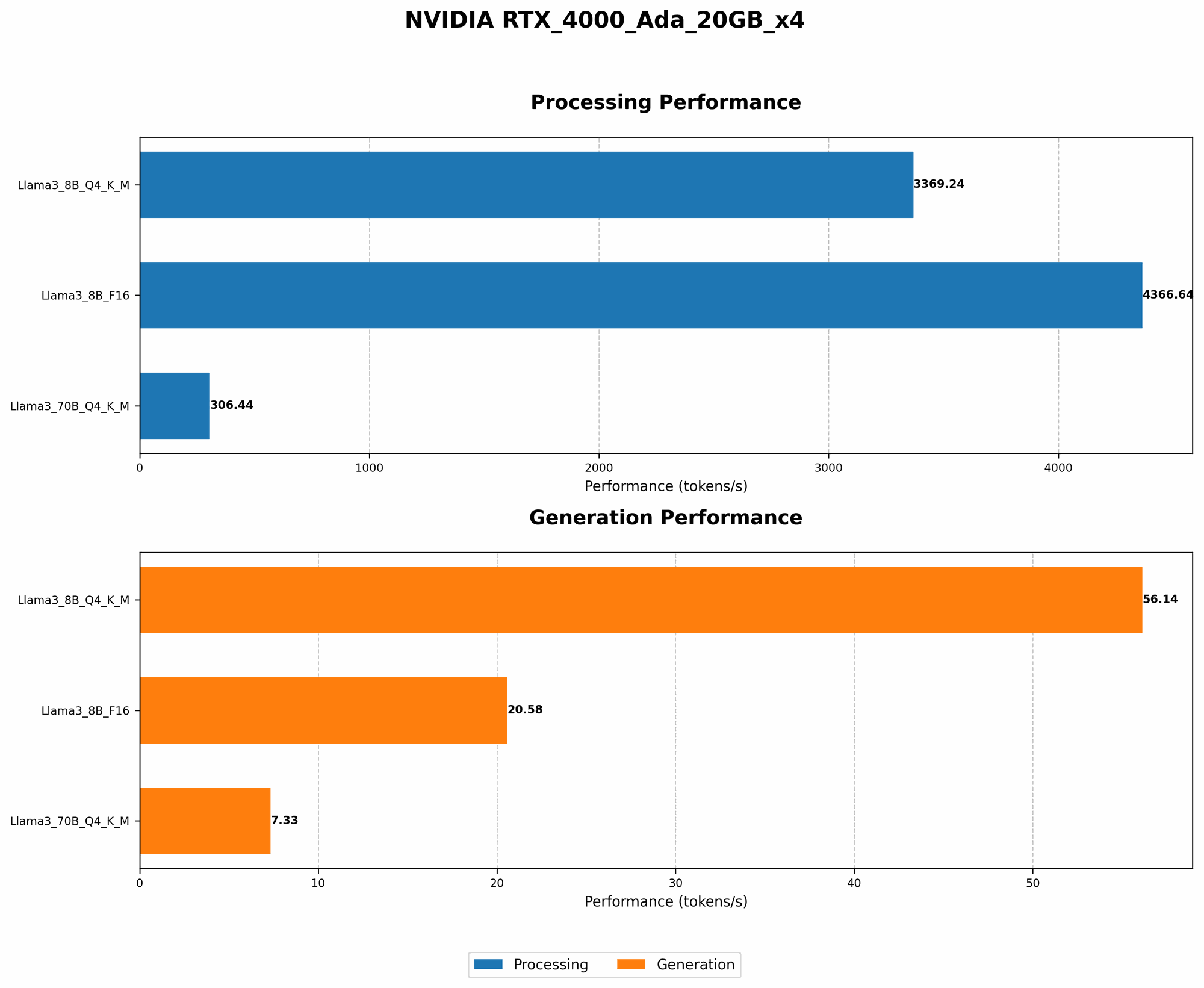
Let's dive right into the numbers! We've measured the token generation speed of Llama3 8B on the RTX4000Ada20GBx4, using two different quantization levels: Q4KM (quantized to 4 bits, with kernel and matrix quantization) and F16 (half-precision floating point).
Token Generation Speed Benchmarks: Apple M1 and Llama2 7B
| Model & Quantization | Tokens/Second |
|---|---|
| Llama3 8B Q4KM | 56.14 |
| Llama3 8B F16 | 20.58 |
As you can see, Llama3 8B with Q4KM quantization delivers a significantly faster token generation speed, clocking in at 56.14 tokens/second compared to 20.58 tokens/second with F16 quantization. This is a testament to the effectiveness of quantization in reducing memory usage and speeding up inference on GPUs.
Performance Analysis: Model and Device Comparison
While the RTX4000Ada20GBx4 is a powerhouse, it's always interesting to see how it stacks up against other devices and model sizes. Sadly, we only have data for the RTX4000Ada20GBx4 and Llama3 8B in this case, so we can't provide a comparative analysis. It would be interesting to see how the performance of Llama3 8B on this GPU compares to other devices like the Apple M1, RTX 3090, or even a cluster of TPUs.
Practical Recommendations: Use Cases and Workarounds
Now let's shift from the raw numbers to real-world applications. What can you actually do with Llama3 8B on the RTX4000Ada20GBx4?
Use Cases
- Real-time chatbots: The high token generation speed of Llama3 8B with Q4KM quantization makes it suitable for building real-time chatbots with low latency. You can imagine having a chatbot that feels as responsive as a human, even for complex conversations.
- Code generation: Llama3 8B can be used for generating code in multiple languages. Think of a tool that can help you write or debug code in Python, JavaScript, or even C++ with just a few prompts.
- Storytelling and creative writing: With its impressive language capabilities, Llama3 8B can be used to generate creative content like stories, poems, and even scripts. This opens up exciting possibilities for aspiring writers and anyone who wants to explore their creativity.
Workarounds
- Model optimization: While the RTX4000Ada20GBx4 is a powerful GPU, running larger models like Llama3 70B might push its limits. To address this, you can explore techniques like model quantization, which can reduce model size and memory footprint without significant loss of accuracy.
- Hardware upgrades: If you need to run even larger models, consider upgrading your hardware. Adding more GPUs to your setup can provide the necessary processing power.
Conclusion
Running Llama3 8B on the NVIDIA RTX4000Ada20GBx4 offers impressive performance, with the Q4KM quantization level providing a significant speed boost for token generation. This makes it a great choice for a wide range of use cases, from real-time chatbots to creative writing. While larger models might require optimization or additional hardware, the RTX4000Ada20GBx4 provides a powerful and efficient platform for exploring the exciting world of local LLMs.
FAQ
Q: What is quantization, and why is it important?
A: Quantization is a technique that reduces the size of a model by representing its weights and activations using fewer bits. This can significantly reduce memory usage and improve inference speed on GPUs. It's like converting a high-resolution image to a lower-resolution version, but for AI models!
Q: Can I run Llama3 70B on the RTX4000Ada20GBx4?
A: While it's theoretically possible, it's unlikely to be efficient due to the large memory requirements of Llama3 70B. You might need to use techniques like quantization or explore hardware upgrades to run it smoothly.
Q: What are the benefits of running LLMs locally?
A: There are several benefits: * Faster inference: You can get results much quicker than using a cloud service. * Privacy: Your data stays on your device, which can be important for sensitive information. * Offline access: You can use the LLM without an internet connection.
Q: What are some other popular open-source LLMs?
A: Besides Llama3, other popular open-source LLMs include: * GPTNeo: A powerful GPT-like model developed by EleutherAI. * BLOOM: A multilingual LLM developed by a collaborative effort of over 1000 researchers. * StableLM: Another GPT-like model developed by Stability AI.
Keywords
LLMs, large language models, Llama3, Llama3 8B, RTX4000Ada20GBx4, NVIDIA, GPU, token generation speed, benchmarks, quantization, Q4KM, F16, performance, local LLMs, inference, use cases, chatbots, code generation, storytelling, creative writing, model optimization, hardware upgrades, open-source, GPTNeo, BLOOM, StableLM.