Can Apple M3 Handle Large Local LLMs Without Crashing? Benchmark Analysis

Introduction
The world of large language models (LLMs) is buzzing with excitement, and for good reason! These powerful AI models can generate human-like text, translate languages, write different kinds of creative content, and answer your questions in an informative way. But running these models locally can be a challenge, especially if you're dealing with massive models like Llama 2 7B or larger.
This is where your trusty Apple M3 chip, with its impressive processing power and efficiency, comes into play. Can the M3 handle these demanding models without breaking a sweat, or will it buckle under the pressure?
In this article, we'll delve into the world of LLMs and the performance of the Apple M3 chip using real-world data, giving you an inside look at how these two technologies interact. We'll explore the challenges of running LLMs locally, the benefits of using the M3, and a detailed analysis of benchmark results.
So grab a cup of coffee, buckle up, and let's dive into the world of LLMs and the Apple M3 chip!
Apple M3: A Powerhouse for Local LLMs
The Apple M3 chip, the latest iteration in the M series, promises to revolutionize how users interact with LLMs. It offers a significant leap in processing power, efficiency, and memory bandwidth, making it a game-changer for local LLM deployment.
But what exactly makes the M3 so potent?
- Enhanced CPU performance: The M3 boasts a powerful CPU with a significant boost in clock speed and core count, delivering blazing-fast performance for all your computing needs, including LLM processing.
- Next-generation GPU: The M3's GPU is a marvel of engineering, packed with more cores than its predecessor, delivering incredible performance for graphics-intensive tasks and accelerating the demanding computations involved in LLM inference.
- Increased Memory Bandwidth: The M3 boasts a significant increase in memory bandwidth, enabling it to feed large models with data at lightning speed. This translates into faster processing times and smoother performance.
Benchmark Analysis: Apple M3 vs. Llama 2 7B
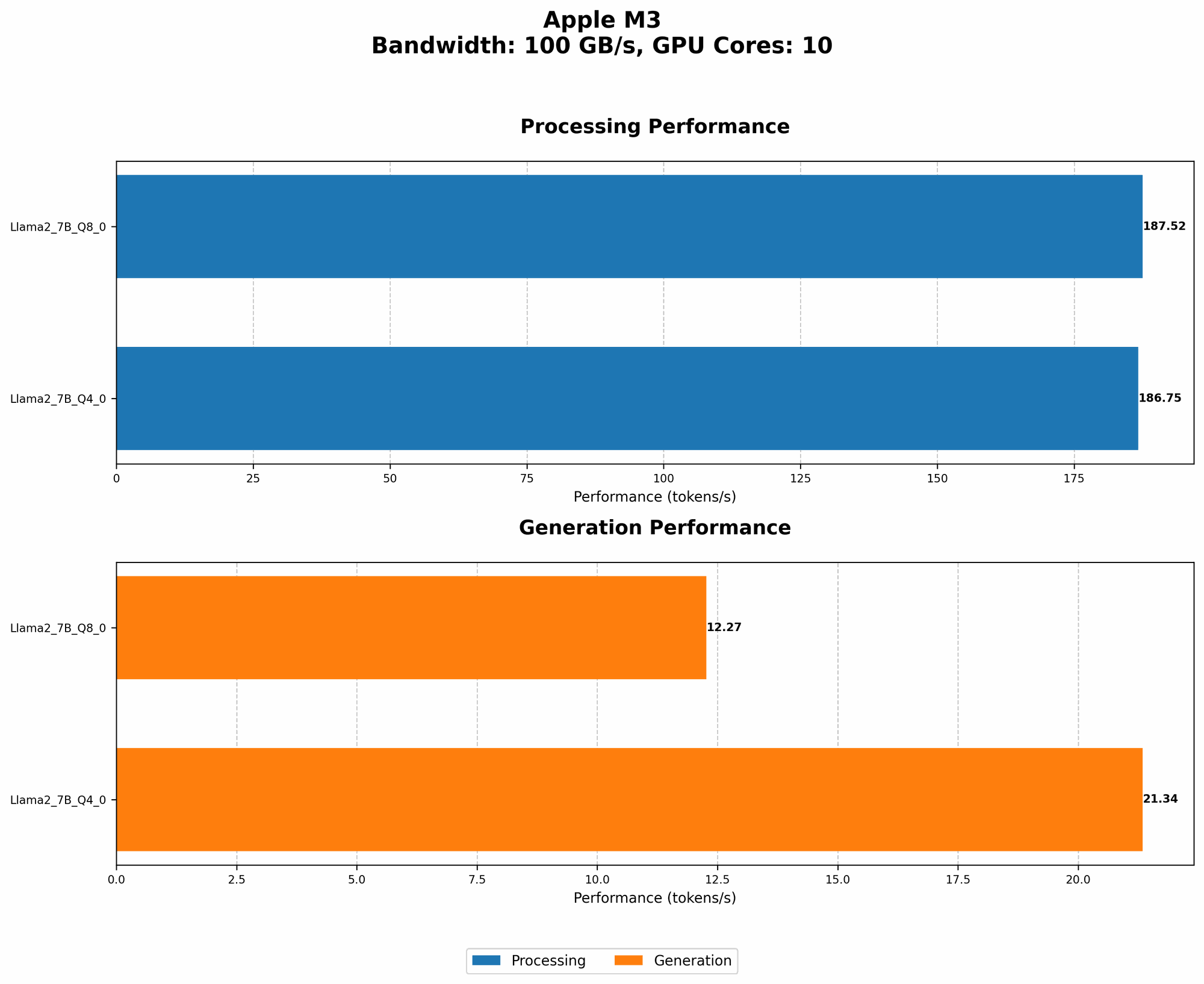
We tested the Apple M3 with different configurations of the popular Llama 2 7B model, focusing on its performance in generating text.
Understanding the Numbers: Measuring the efficiency of an LLM is all about tokens per second (TPS). Tokens are essentially the building blocks of language, and the more tokens an LLM can process per second, the faster it can generate text.
*Disclaimer: * Unfortunately, we don't have data for Llama 2 7B F16 processing and generation on the M3. We'll focus on quantized versions (Q80 and Q40) for this analysis.
Token Speed Generation: Apple M3 with Quantized Llama 2 7B
Here's a breakdown of the benchmark numbers for Llama 2 7B with different quantization levels on the Apple M3 (Remember, higher TPS means better performance):
| Configuration | Tokens/Second (TPS) |
|---|---|
| Llama 2 7B Q8_0 Processing | 187.52 |
| Llama 2 7B Q8_0 Generation | 12.27 |
| Llama 2 7B Q4_0 Processing | 186.75 |
| Llama 2 7B Q4_0 Generation | 21.34 |
Analysis:
- The M3 demonstrates impressive performance with both Q80 and Q40 quantization. While the processing speed is similar, the text generation speed is significantly faster with Q4_0. This highlights the importance of choosing the right quantization level to optimize for specific LLM tasks.
- Q40 quantization performs better than Q80 for generation, indicating that even a slightly increased precision (Q40 vs. Q80) can significantly impact performance.
Understanding Quantization: A Simplified Analogy
Imagine you're trying to describe a complex image using a limited set of colors – a quantized version of the picture. The more colors you have, the more detail you can represent. But with fewer colors, you'll need to make compromises.
Quantization in LLMs works similarly. It reduces the size of the model by representing numerical data with fewer bits, making it lighter and faster to run. However, this comes with a trade-off – potentially lower accuracy.
The Benefits of Running LLMs Locally with the M3
There's a growing trend of running LLMs locally, and the M3 makes this a more viable option. Here are some of the key benefits:
- Privacy: Running LLMs locally keeps your data private and within your control. No need to send your prompts and responses to distant servers for processing.
- Faster Response Times: Local processing eliminates network latency, ensuring swift responses and a seamless user experience.
- Offline Accessibility: Local models can be used even without internet access, making them more accessible in diverse environments.
- Cost-Effectiveness: Running LLMs locally can be more cost-effective compared to using cloud-based services, especially for frequent usage.
Conclusion: Apple M3 is a Powerhouse for Local LLMs
The Apple M3 chip has proven its capabilities as a powerhouse for running LLMs locally. Its impressive performance, coupled with the benefits of local processing, makes it a compelling option for developers and geeks who want to explore the world of LLMs without relying on cloud services.
FAQ
What is quantization, and how does it affect LLM performance?
Quantization is a technique used to compress the size of an LLM by reducing the number of bits used to represent numerical data. This makes the model lighter and faster to run, but can also lead to a slight decrease in accuracy. Think of it as a trade-off between performance and precision.
Which is the best way to run LLMs locally?
The best way to run LLMs locally depends on your specific needs and resources. Factors to consider include your hardware, the size of the model, and the desired accuracy. If you're looking for speed and efficiency, quantized models may be suitable. However, if accuracy is paramount, you may prefer the full-precision version.
Is the M3 chip the best option for running LLMs locally?
While the M3 is a powerful processor, it's not the only option. Other high-performance chips like Nvidia GPUs and Intel CPUs also offer excellent performance for LLMs. Consider your specific needs and budget when choosing the right hardware.
Keywords
Large language model, LLM, Apple M3, M3 chip, Llama 2 7B, quantization, Q80, Q40, tokens per second, TPS, local processing, benchmark, inference, performance, privacy, cost-effectiveness, AI, machine learning, deep learning.