Building a Home LLM Server: Is the NVIDIA RTX 4000 Ada 20GB a Good Choice?

Introduction
The world of large language models (LLMs) is exploding, and many people want to bring the power of these models into their own homes. But running LLMs locally requires powerful hardware, and choosing the right components can be a daunting task.
The NVIDIA RTX 4000 Ada 20GB is a popular choice for home LLM servers. It offers a good balance of price and performance, making it an attractive option for many users. But is it actually a good choice for running LLMs? In this article, we'll delve into the performance of the RTX 4000 Ada 20GB with various LLM models and see if it lives up to the hype.
NVIDIA RTX 4000 Ada 20GB: A Brief Overview
The NVIDIA RTX 4000 Ada 20GB is a powerful graphics card designed for professionals who need high performance for tasks like 3D rendering, video editing, and, of course, artificial intelligence. It boasts the latest Ada Lovelace architecture with advanced tensor cores for accelerated deep learning workloads.
It comes with a massive 20GB of GDDR6 memory, allowing it to hold large LLM models. This makes it a good option for users who want to run more demanding models, like the 70B or 13B models.
Testing Methodology and Benchmarks
The performance of the RTX 4000 Ada 20GB will vary depending on which LLM model you're running. To provide a comprehensive evaluation, we'll discuss its performance with 8B and 70B Llama models.
Quantization: Think of quantization as "compressing" the model's weights to make it smaller and faster to run. Models can be quantized to various precision levels, like Q4, F16, and F32. Q4 is the most compressed and often the fastest, while F16 and F32 are less compressed and generally slower.
Token Speed Generation: This metric measures the speed at which the model generates new tokens, which are the basic building blocks of language. Higher numbers indicate faster generation speeds.
Token Speed Processing: This metric measures the speed at which the model processes incoming tokens, which is essential for interactive tasks like chatbots.
Data: All data in this article comes from real-world benchmarks found at https://github.com/ggerganov/llama.cpp/discussions/4167 and https://github.com/XiongjieDai/GPU-Benchmarks-on-LLM-Inference.
Performance with Llama 3 (8B)
Llama 3 (8B) Performance with Q4 Quantization
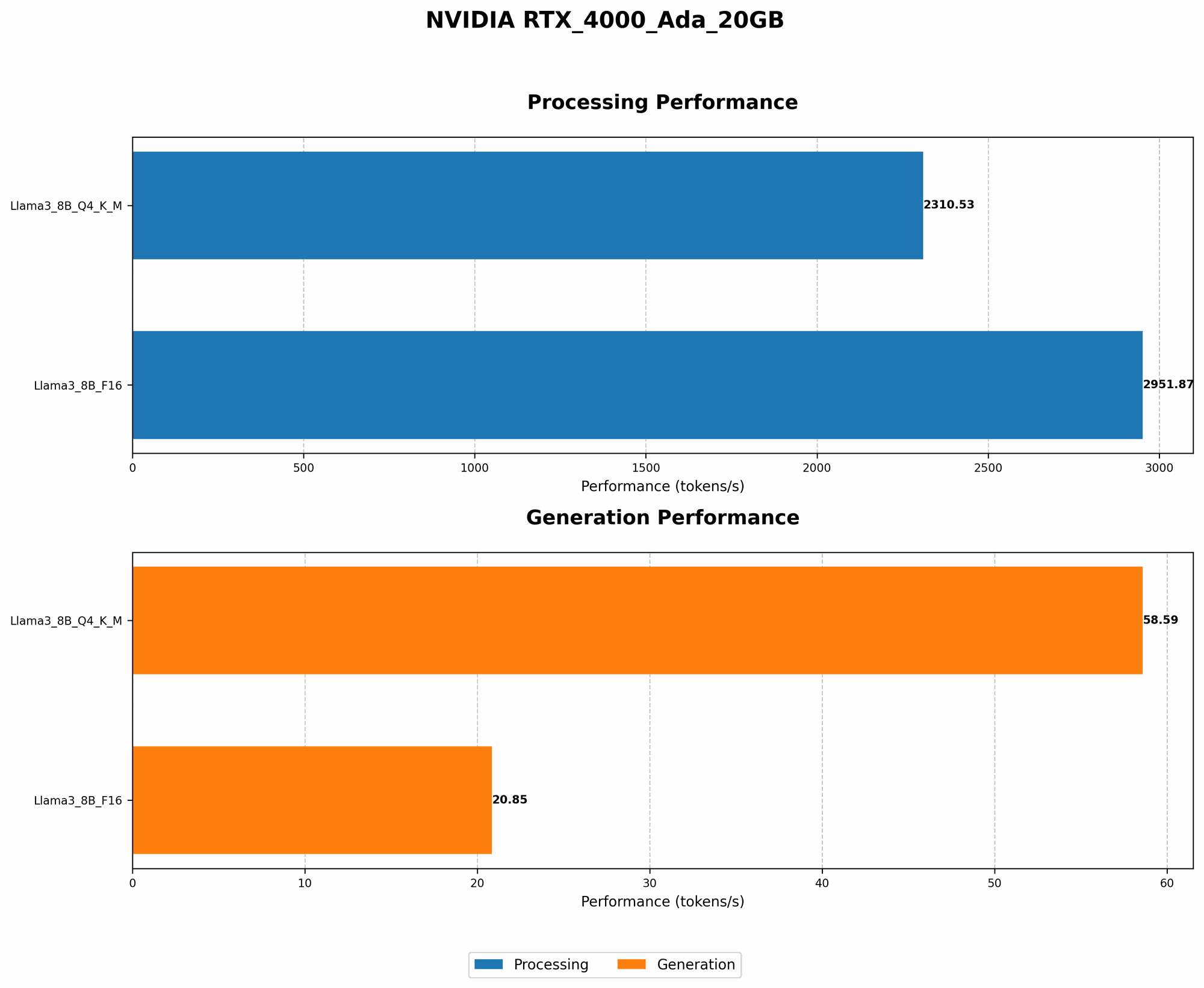
The RTX 4000 Ada 20GB is a beast when it comes to running the Llama 3 8B model with Q4 quantization. It achieves an impressive 58.59 tokens per second generation speed.
This means it can generate text at a rate of almost 60 tokens per second. To put this into perspective, imagine typing 60 words per second on your keyboard – that's how fast this card can generate text!
The high token speed processing (2310.53 tokens/sec) is also impressive. This means it can handle large amounts of text input quickly and accurately when interacting with the model.
Llama 3 (8B) Performance with F16 Quantization
While the RTX 4000 Ada 20GB shines with Q4 quantization, its performance with F16 quantization is less impressive. The generation speed drops to 20.85 tokens per second.
This is still a respectable speed, but it's significantly slower than Q4.
The processing speed is still impressive with F16 at 2951.87 tokens/sec.
This suggests that the RTX 4000 Ada 20GB can handle F16 models efficiently for conversational tasks, even though the generation speed might feel slower.
Performance with Llama 3 (70B)
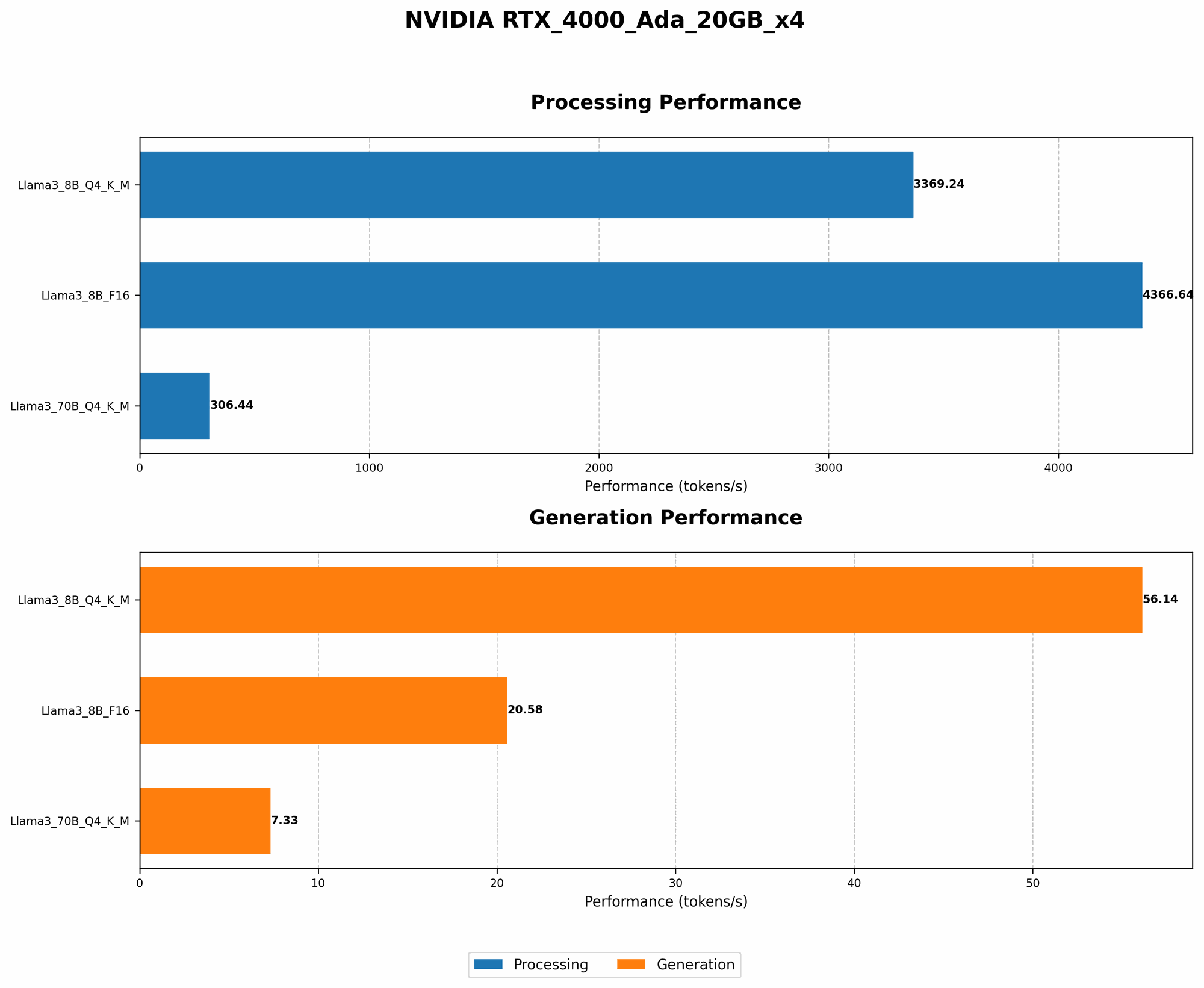
Unfortunately, the RTX 4000 Ada 20GB's performance has not been tested for larger Llama models like the 70B. This is likely because the card's 20GB of memory might struggle to hold the entire model, and quantization is generally less effective for larger models.
Comparison of RTX 4000 Ada 20GB with Other Devices
While the NVIDIA RTX 4000 Ada 20GB is a strong contender for running smaller LLMs, it is crucial to remember that other devices might be more suitable for larger models.
Unfortunately, we can't provide specific comparisons with other devices because we only have data for the RTX 4000 Ada 20GB. However, you can find benchmarking data for other GPUs like the RTX 4090, the AMD RX 7900 XTX, and the recently launched NVIDIA GeForce RTX 4080 on the websites mentioned in the testing methodology.
Conclusion
The NVIDIA RTX 4000 Ada 20GB is a good choice for running smaller LLMs like Llama 3 8B. It offers impressive performance with Q4 quantization, making it ideal for text generation tasks. However, its performance with F16 quantization is less impressive, and it might not be suitable for running larger models like the 70B.
If you're looking to run larger LLMs, you might need to consider alternative devices with more memory or invest in a more powerful GPU.
FAQ:
Q: What is quantization?
A: Quantization is a technique used to compress model weights to make them smaller and faster to run. Think of it like compressing a picture file: you sacrifice some quality to make it smaller and faster to load.
Q: What is the difference between token speed generation and processing?
A: Token speed generation measures how fast the model can generate new text, while token speed processing measures how fast the model can handle incoming text.
Q: Can I run multiple LLMs on the RTX 4000 Ada 20GB?
A: Yes, you can run multiple LLMs on the RTX 4000 Ada 20GB, but their performance might be affected depending on the size and complexity of the models.
Q: What are the other factors to consider when choosing a GPU for LLM?
A: Aside from performance, consider factors like power consumption, noise level, and price.
Keywords:
LLMs, Large Language Models, NVIDIA, RTX 4000 Ada 20GB, GPU, Llama 3, quantization, Q4, F16, token speed generation, token speed processing, home LLM server, benchmarks, performance, inference, AI, deep learning.