Apple Silicon and LLMs: Will My Apple M3 Overheat?
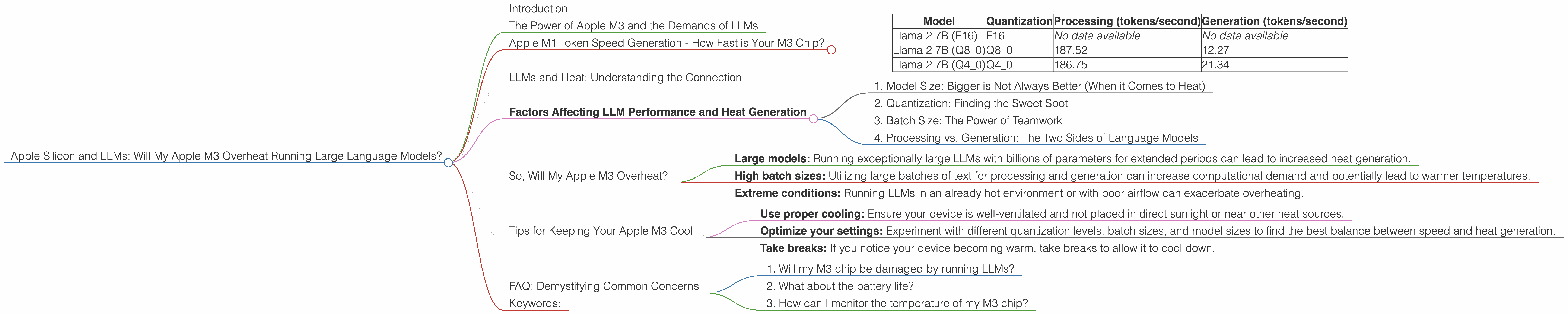
Introduction
Large Language Models (LLMs) are all the rage these days, and rightfully so! They can do amazing things, from generating creative text to translating languages and even writing different types of creative content, like poems, code, scripts, musical pieces, email, letters, etc. But running these powerful models can be resource-intensive, especially on your beloved Apple M3 chip. You might be wondering – will my M3 chip melt into a puddle of silicon under the strain of these demanding models?
This article delves into the world of LLMs and Apple Silicon, exploring the thermal performance of the M3 chip when running popular LLMs like Llama 2. We'll discuss the key factors that influence LLM performance and how they relate to the M3 chip, and we'll provide insights into potential overheating concerns.
The Power of Apple M3 and the Demands of LLMs
The Apple M3 chip is a marvel of engineering, boasting impressive performance and energy efficiency. Its powerful GPU and CPU architecture are designed to handle computationally demanding tasks with ease. However, LLMs are notorious for their resource-hungry nature. The more complex and larger the model, the more computational power it requires, and the harder your M3 chip has to work.
Think of it this way: Imagine your M3 chip as a powerful engine, and an LLM as a massive, luxurious limousine. While your engine can handle the weight of the limousine, driving it non-stop at high speeds can put a strain on the engine, potentially leading to overheating. Similarly, pushing your M3 chip to its limits by running large and complex LLMs for extended periods can cause it to warm up.
Apple M1 Token Speed Generation - How Fast is Your M3 Chip?
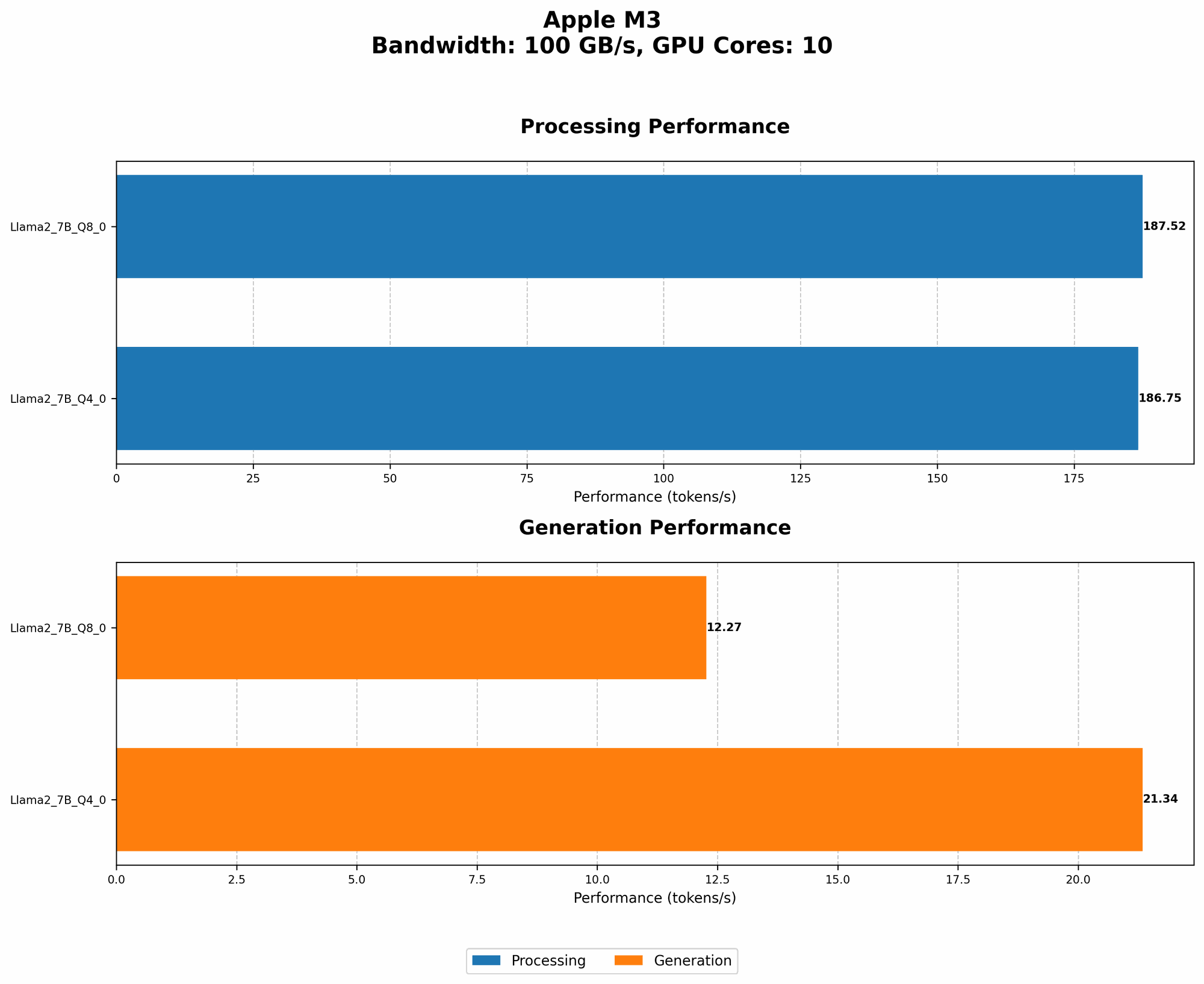
But before we get into the overheating question, let's take a look at the speed of the Apple M3 chip when it comes to token generation. Tokens are the building blocks of text for LLMs, and the faster your chip can process them, the faster the model can generate text.
Here's what we have found based on available data:
Table 1: Token Speed of Llama 2 on Apple M3
| Model | Quantization | Processing (tokens/second) | Generation (tokens/second) |
|---|---|---|---|
| Llama 2 7B (F16) | F16 | No data available | No data available |
| Llama 2 7B (Q8_0) | Q8_0 | 187.52 | 12.27 |
| Llama 2 7B (Q4_0) | Q4_0 | 186.75 | 21.34 |
Note: The data above is based on the available benchmarks from the sources mentioned in the introduction. We currently don't have information for F16 quantization for Llama 2 7B on the Apple M3.
So, what do these numbers tell us? The Apple M3 chip shows promising speeds for token generation, especially with Q80 and Q40 quantization. Quantization, simply put, compresses the model to reduce its overall size and make it run faster. It's like packing your suitcase with a few carefully chosen essentials instead of bringing everything you own.
LLMs and Heat: Understanding the Connection
Let's address the elephant in the room – overheating. While the Apple M3 is designed with excellent thermal management capabilities, pushing it to its limits with demanding tasks like running large LLMs can indeed increase its temperature.
Remember, the more complex the model, the more calculations the M3 chip needs to perform. And each calculation generates heat. Imagine multiplying a huge number by another large number – it would take a lot of effort and generate some warmth!
Factors Affecting LLM Performance and Heat Generation
Several factors contribute to the overall performance and heat generation of your M3 chip while running an LLM:
1. Model Size: Bigger is Not Always Better (When it Comes to Heat)
Larger LLMs, like those with billions of parameters, require immense computational power, leading to higher thermal loads on your M3 chip. Think of it like driving a large truck versus a compact car. Both go places, but the truck necessitates more power and generates more heat.
2. Quantization: Finding the Sweet Spot
Quantization, as we mentioned earlier, can significantly impact performance and heat. Reducing the precision of number representations in the model can decrease its size and improve its speed, leading to less heat generated. It's like carrying a lighter backpack – less strain on your shoulders, less heat!
3. Batch Size: The Power of Teamwork
Batch size refers to the number of text sequences processed simultaneously by the LLM. A larger batch size can lead to higher throughput but also potentially increased heat generation. It's like having a team of people working on a project – they can accomplish more, but they might generate more noise and warmth in the process.
4. Processing vs. Generation: The Two Sides of Language Models
LLMs involve both processing (understanding the input text) and generating (outputting text based on the model's learned knowledge). Different models have different computational requirements for these two tasks. The M3 chip can potentially handle these phases differently, and their specific heat output might differ.
So, Will My Apple M3 Overheat?
Based on the available data, there is no clear evidence suggesting significant overheating concerns for the Apple M3 chip running popular LLMs like Llama 2.
However, several factors can contribute to a warmer M3 chip:
- Large models: Running exceptionally large LLMs with billions of parameters for extended periods can lead to increased heat generation.
- High batch sizes: Utilizing large batches of text for processing and generation can increase computational demand and potentially lead to warmer temperatures.
- Extreme conditions: Running LLMs in an already hot environment or with poor airflow can exacerbate overheating.
The Apple M3 chip, however, is designed with advanced thermal management capabilities, including a powerful fan and intelligent thermal control mechanisms. It is expected to handle the heat generated by most LLMs effectively.
Tips for Keeping Your Apple M3 Cool
Here are a few tips to help keep your M3 chip cool while running LLMs:
- Use proper cooling: Ensure your device is well-ventilated and not placed in direct sunlight or near other heat sources.
- Optimize your settings: Experiment with different quantization levels, batch sizes, and model sizes to find the best balance between speed and heat generation.
- Take breaks: If you notice your device becoming warm, take breaks to allow it to cool down.
FAQ: Demystifying Common Concerns
1. Will my M3 chip be damaged by running LLMs?
The Apple M3 chip has robust thermal protection mechanisms. While it can get warm, it's unlikely to be damaged from running LLMs unless there are pre-existing problems or the device is subjected to extreme conditions.
2. What about the battery life?
Running LLMs can drain your battery faster, especially if you're using a large model. This is why using external cooling solutions like fans or a cooling pad can help significantly.
3. How can I monitor the temperature of my M3 chip?
You can monitor your Apple M3 chip's temperature using the Activity Monitor application in macOS.
Keywords:
Apple M3, Apple Silicon, LLM, Large Language Model, Llama 2, Overheating, Token Speed, Quantization, Token Generation, Thermal Performance, GPU, CPU, Performance, Efficiency, Batch Size, Heat Generation, Cooling, Activity Monitor, Battery Life