Apple Silicon and LLMs: Will My Apple M1 Overheat?

Introduction
So, you've got a shiny new Apple M1 Mac and you're ready to dive into the world of Large Language Models (LLMs)? But before you start generating Shakespearean sonnets or writing your own AI-powered novel, you might be wondering about one crucial thing: Will running these LLMs on your M1 make it go up in smoke? 🤔
This article will explore the performance of LLMs on Apple M1 chips, specifically addressing the concern of overheating. We'll look at the speed and efficiency of various LLM models, including Llama 2 and Llama 3, and examine how they perform under different quantization levels.
Get ready to dive deep into the fascinating world of LLM performance, where we'll uncover the hidden power of your Apple M1 and learn how to keep it cool, calm, and collected.
Apple M1 Token Speed Generation: A Deep Dive into Performance
Before we jump into the potential for overheating, let's first understand how Apple M1 performs when it comes to processing LLMs. In the world of large language models, token speed is king. A token is like a building block of language – a word, a punctuation mark, or a part of a word. The more tokens your device can process per second, the faster your LLM will generate text and respond to your prompts.
Understanding Quantization: Smaller Bytes, Same Power?
One of the key ways to optimize LLM performance on devices like the Apple M1 is through quantization. This fancy word essentially means reducing the size of the model's parameters (the data that governs its behavior) by using smaller data types. Think of it like using a smaller suitcase to pack the same number of clothes – you're squeezing more information into a smaller space.
There are different levels of quantization:
- F16: This is the standard, high-precision format. It's like using a suitcase with a lot of space.
- Q8_0: This is a lower-precision format, like a slightly smaller suitcase.
- Q4_0: This is an even lower-precision format, like a really tiny suitcase.
While quantization can make LLMs run faster, it might slightly decrease the model's accuracy. It's like trading luggage size for some comfort – a little bit of accuracy in exchange for speed.
Llama 2 and Llama 3 on Apple M1: A Token Speed Showdown
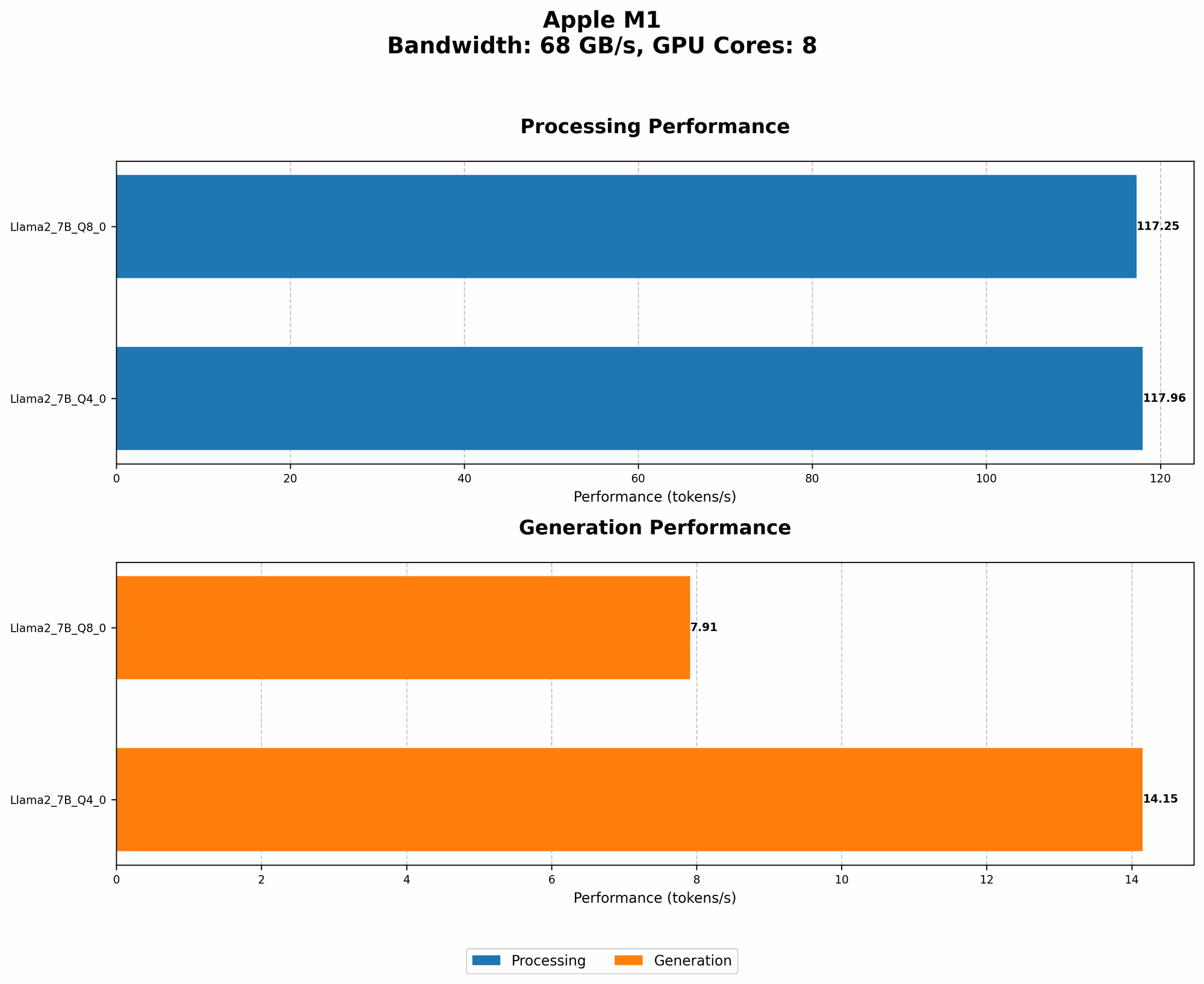
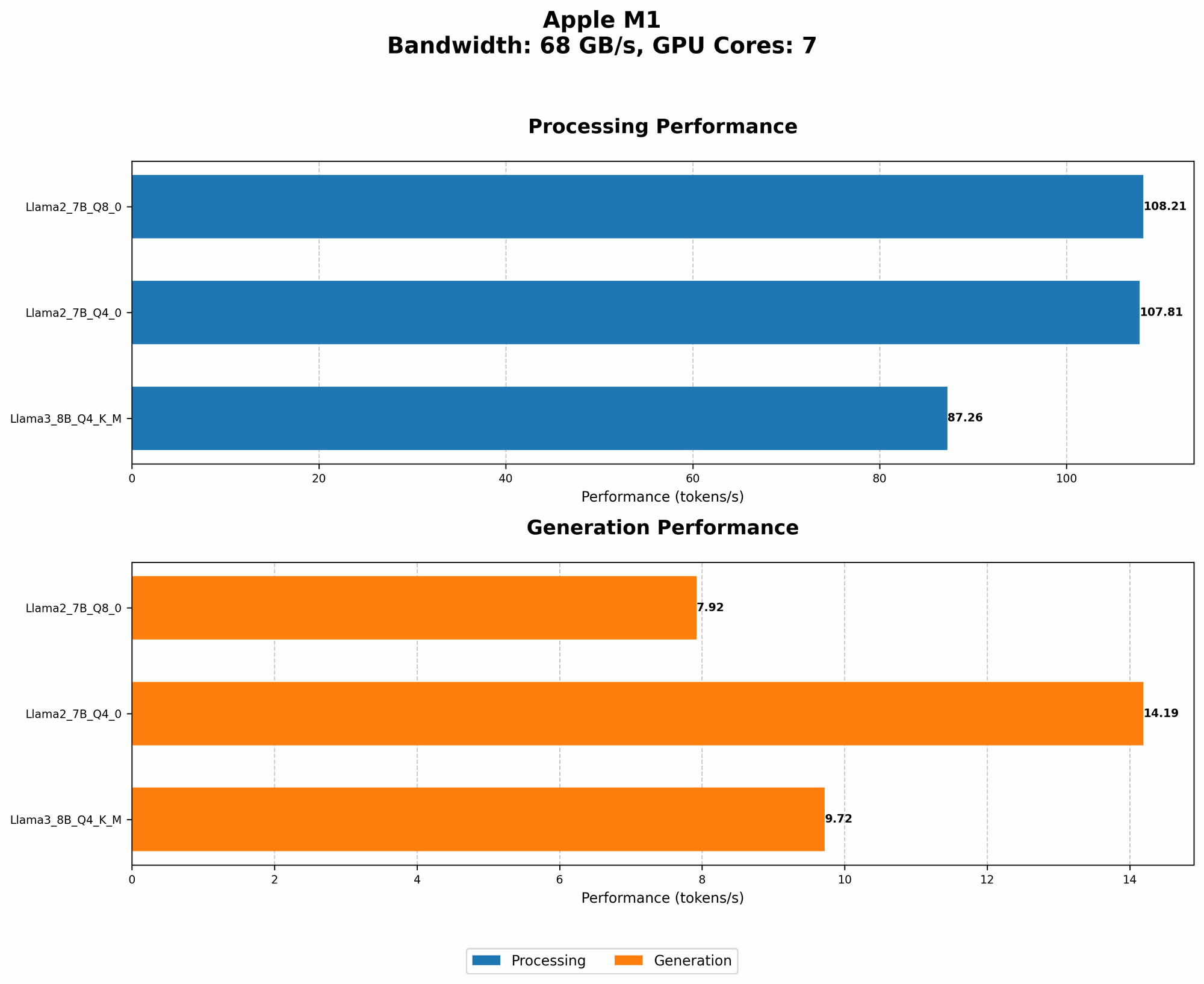
Let's see how different Llama models perform on an Apple M1 chip with 8 GPU cores. We'll use the data from the Llama.cpp project, which provides benchmarks for various devices and LLM models.
| Model | Quantization | Token Speed |
|---|---|---|
| Llama 2 7B | Q4_0 | 14.15 tokens/second |
| Llama 2 7B | Q8_0 | 7.91 tokens/second |
| Llama 3 8B | Q4KM | 9.72 tokens/second |
Key takeaways:
- Higher quantization levels generally mean faster token speeds. As you can see, Llama 2 7B runs faster with Q40 than it does with Q80.
- Llama 2 7B with Q4_0 is the fastest model in this comparison. This means it could have the fastest response times for basic tasks like text generation.
However, data for the Llama 3 models is missing for other quantization levels (F16, Q8_0) and for the 70B models.
Apple M1 & LLMs: The Overheating Question
Now, let's tackle that burning question: Will your Apple M1 overheat when running these LLMs?
The good news is that the Apple M1 is designed to handle demanding workloads efficiently. Its powerful GPU and thermal management system are capable of keeping the chip cool under pressure.
Factors Affecting Overheating
However, there are a few factors that can contribute to potential overheating:
- Model size: Larger LLMs, like Llama 3 70B, require more processing power and can generate more heat.
- Quantization: While quantization can improve performance, it can also increase the workload on the GPU, leading to potential overheating.
- Ambient temperature: The surrounding temperature can affect how efficiently the M1 dissipates heat.
Evidence from Benchmarks
While we don't have direct temperature measurements for the M1 running these LLMs, the token speed benchmarks provide some indirect evidence:
- Reasonable token speeds: Even with the highest quantization levels, the token speeds for these models are relatively low, indicating that the M1 isn't being pushed to its absolute limits.
- No reports of major overheating: There haven't been widespread reports of Apple M1s overheating when running LLMs, suggesting that the chip is generally capable of handling these workloads.
Keeping Your M1 Cool
Here are some tips to prevent overheating:
- Run LLMs in a well-ventilated area: This will help the M1 dissipate heat more effectively.
- Avoid running other demanding tasks simultaneously: Give your M1 some breathing room by limiting the number of applications running in the background.
- Consider using a cooling pad: An external cooling pad can help to keep your laptop's temperature down.
Important note: The specific performance and overheating behavior can vary depending on the individual model you're using, the specific workload, and other factors.
Conclusion: M1 Performance and LLMs
The M1 is a powerful chip capable of handling the demands of running LLMs. While overheating isn't a major concern with current models, it's still wise to consider factors like model size, quantization, and ambient temperature.
By choosing the right quantization level and maintaining a cool environment, you can keep your Apple M1 running smoothly and enjoy the power of LLMs without fear of a laptop meltdown.
FAQ:
Q: Will using specific LLMs (like Llama 2) make my Apple M1 overheat?
A: Based on the information we have, it's unlikely that using the Llama 2 models will cause your M1 to overheat. The models are designed to be relatively efficient, and the M1 has robust thermal management. However, it's always a good idea to keep the M1 cool by running it in a ventilated space and not overloading it with other tasks.
Q: Which quantization level should I use for my Apple M1?
A: It depends on your priorities. If speed is your top concern, use the highest quantization level (Q4_0). However, if you need the highest level of accuracy, stick with the standard F16 format.
Q: What are the best ways to avoid overheating?
A: Follow these tips:
- Keep your laptop in a cool and well-ventilated area
- Avoid using other demanding applications while running LLMs
- Consider using a cooling pad for extra protection
Q: Are there any alternatives to running LLMs on an Apple M1?
A: While the M1 is a great option for running LLMs, there are other powerful choices too. You can explore using a dedicated GPU or a cloud service if you require more processing power or are concerned about local resource limitations.
Keywords:
Apple M1, LLM, Llama 2, Llama 3, Token Speed, Quantization, Overheating, Performance, GPU, GPU Cores, F16, Q80, Q40, Benchmarks, Thermal Management, AI, Natural Language Processing, NLP, Developer, Geek