Apple M2 Max 400gb 30cores vs. Apple M3 Max 400gb 40cores for LLMs: Which is Faster in Token Generation Speed? Benchmark Analysis
Introduction
The ever-growing popularity of Large Language Models (LLMs) has fueled a demand for powerful hardware capable of handling their massive computational requirements. Apple's M-series chips, known for their impressive performance and energy efficiency, have emerged as strong contenders for running LLMs locally. This article delves into the speed comparison of two of Apple's latest chips, the M2 Max 400gb 30cores and M3 Max 400gb 40cores, focusing on their token generation speed for different LLM models.
We will analyze the performance of these chips across popular LLM models like Llama 2 and Llama 3, using various quantization levels. This benchmark analysis will help developers and enthusiasts understand the strengths and weaknesses of each chip and make informed decisions based on their specific needs.
Comparing Apple M2 Max and M3 Max for LLM Token Generation Speed
This section will dissect the performance of the M2 Max and M3 Max chips in generating tokens for different LLM models, providing a detailed breakdown of their speeds across various quantization levels.
Apple M2 Max Token Speed Generation
The M2 Max, with its 30-core GPU and 400GB of memory, is a powerhouse for local AI tasks. Let's look at its performance with various LLM models:
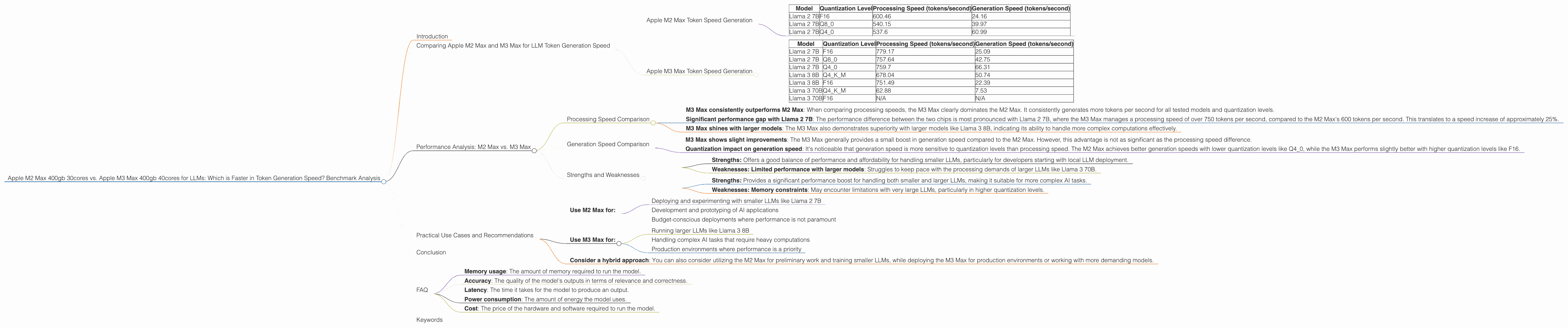
| Model | Quantization Level | Processing Speed (tokens/second) | Generation Speed (tokens/second) |
|---|---|---|---|
| Llama 2 7B | F16 | 600.46 | 24.16 |
| Llama 2 7B | Q8_0 | 540.15 | 39.97 |
| Llama 2 7B | Q4_0 | 537.6 | 60.99 |
As you can see, the M2 Max performs quite well with Llama 2 7B, achieving processing speeds of over 500 tokens per second, even with Q4_0 quantization. This suggests that the M2 Max is capable of handling the computational demands of smaller LLMs effectively.
Apple M3 Max Token Speed Generation
The M3 Max, with its 40-core GPU and 400GB of memory, represents Apple's latest and greatest in terms of AI performance. Let's examine its performance with different LLM models:
| Model | Quantization Level | Processing Speed (tokens/second) | Generation Speed (tokens/second) |
|---|---|---|---|
| Llama 2 7B | F16 | 779.17 | 25.09 |
| Llama 2 7B | Q8_0 | 757.64 | 42.75 |
| Llama 2 7B | Q4_0 | 759.7 | 66.31 |
| Llama 3 8B | Q4KM | 678.04 | 50.74 |
| Llama 3 8B | F16 | 751.49 | 22.39 |
| Llama 3 70B | Q4KM | 62.88 | 7.53 |
| Llama 3 70B | F16 | N/A | N/A |
The M3 Max displays a noticeable performance improvement over the M2 Max, especially with Llama 2 7B. Its processing speeds exceed 750 tokens per second across various quantization levels, indicating a significant leap in performance. The M3 Max also demonstrates its capability with larger models like Llama 3 8B, achieving decent processing and generation speeds. However, it struggles with the massive Llama 3 70B model, especially in F16 quantization, which could be due to memory limitations.
Performance Analysis: M2 Max vs. M3 Max
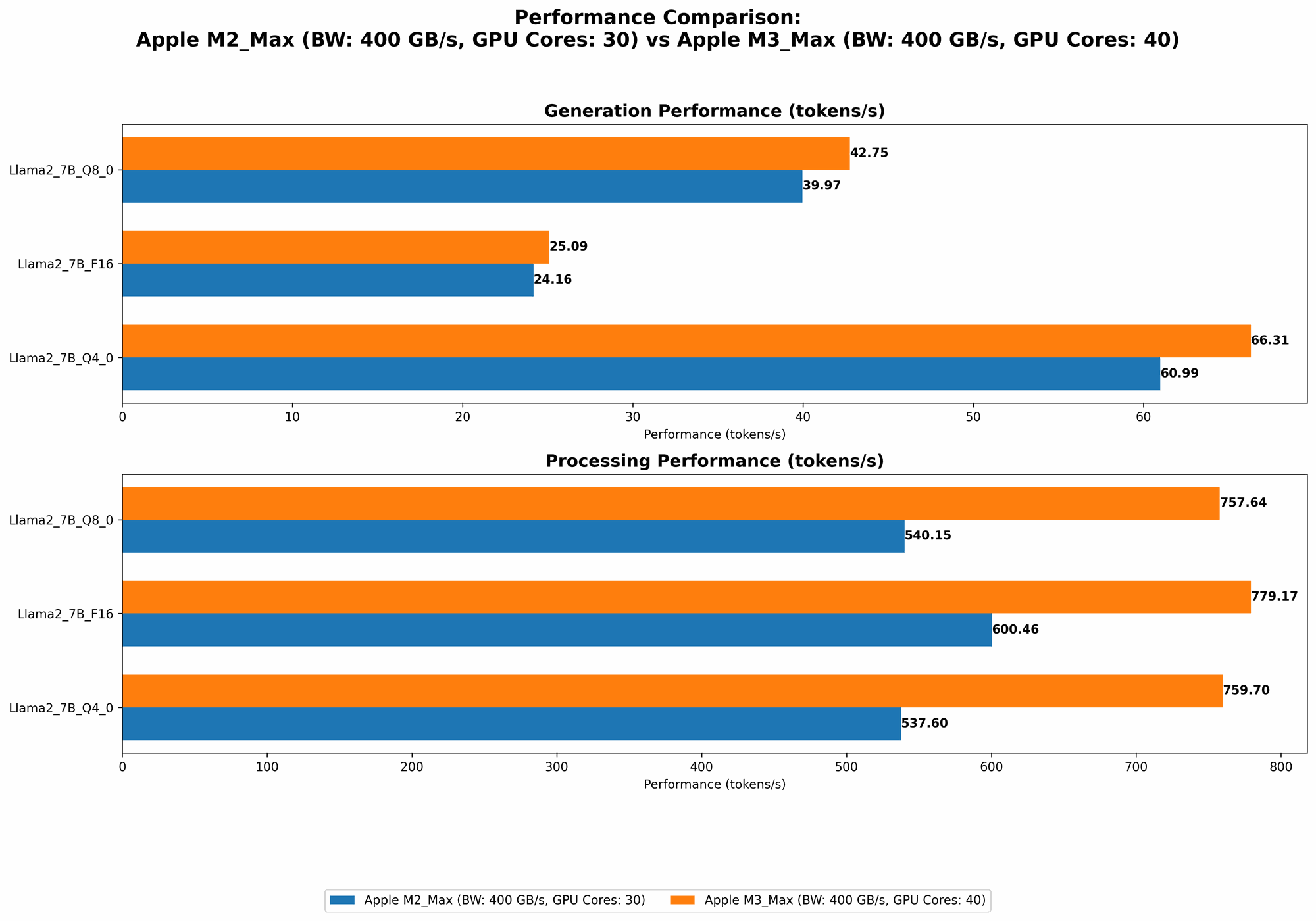
Let's examine the performance differences between the M2 Max and M3 Max in detail:
Processing Speed Comparison
- M3 Max consistently outperforms M2 Max: When comparing processing speeds, the M3 Max clearly dominates the M2 Max. It consistently generates more tokens per second for all tested models and quantization levels.
- Significant performance gap with Llama 2 7B: The performance difference between the two chips is most pronounced with Llama 2 7B, where the M3 Max manages a processing speed of over 750 tokens per second, compared to the M2 Max's 600 tokens per second. This translates to a speed increase of approximately 25%.
- M3 Max shines with larger models: The M3 Max also demonstrates superiority with larger models like Llama 3 8B, indicating its ability to handle more complex computations effectively.
Generation Speed Comparison
- M3 Max shows slight improvements: The M3 Max generally provides a small boost in generation speed compared to the M2 Max. However, this advantage is not as significant as the processing speed difference.
- Quantization impact on generation speed: It's noticeable that generation speed is more sensitive to quantization levels than processing speed. The M2 Max achieves better generation speeds with lower quantization levels like Q4_0, while the M3 Max performs slightly better with higher quantization levels like F16.
Strengths and Weaknesses
M2 Max:
- Strengths: Offers a good balance of performance and affordability for handling smaller LLMs, particularly for developers starting with local LLM deployment.
- Weaknesses: Limited performance with larger models: Struggles to keep pace with the processing demands of larger LLMs like Llama 3 70B.
M3 Max:
- Strengths: Provides a significant performance boost for handling both smaller and larger LLMs, making it suitable for more complex AI tasks.
- Weaknesses: Memory constraints: May encounter limitations with very large LLMs, particularly in higher quantization levels.
Practical Use Cases and Recommendations
The choice between the M2 Max and M3 Max depends on your specific use case and budget:
- Use M2 Max for:
- Deploying and experimenting with smaller LLMs like Llama 2 7B
- Development and prototyping of AI applications
- Budget-conscious deployments where performance is not paramount
- Use M3 Max for:
- Running larger LLMs like Llama 3 8B
- Handling complex AI tasks that require heavy computations
- Production environments where performance is a priority
- Consider a hybrid approach: You can also consider utilizing the M2 Max for preliminary work and training smaller LLMs, while deploying the M3 Max for production environments or working with more demanding models.
Conclusion
The Apple M2 Max and M3 Max are both powerful options for running LLMs locally. The M3 Max offers a significant performance advantage, particularly with larger models, making it a superior choice for computationally intensive tasks. However, the M2 Max remains a viable option for budget-conscious developers who work primarily with smaller LLM models. Ultimately, the best choice depends on your specific use case and requirements.
FAQ
Q: What is quantization? A: Quantization is a technique used to reduce the size of LLMs and make them more efficient to run. It works by reducing the number of bits used to represent each number, which can significantly decrease memory usage and computational demands.
Q: What are the different quantization levels? A: Common quantization levels include F16, Q80, and Q40. F16 uses 16 bits for each number, while Q80 and Q40 use 8 and 4 bits, respectively. Generally, lower quantization levels (like Q4_0) lead to smaller model sizes and faster processing speeds but can sometimes result in a slight loss of accuracy.
Q: What is the difference between processing speed and generation speed? A: Processing speed refers to the speed at which the LLM can process the input text and generate the hidden state representation. Generation speed refers to the speed at which the LLM can generate the output text from the hidden state representation.
Q: Are there any other factors I should consider besides token generation speed? A: Yes, other important factors include:
- Memory usage: The amount of memory required to run the model.
- Accuracy: The quality of the model's outputs in terms of relevance and correctness.
- Latency: The time it takes for the model to produce an output.
- Power consumption: The amount of energy the model uses.
- Cost: The price of the hardware and software required to run the model.
Keywords
Apple M2 Max, Apple M3 Max, LLM, Llama 2, Llama 3, Token Generation Speed, Quantization, Processing Speed, Generation Speed, Local AI, Benchmark Analysis, Performance Comparison, GPU, AI Development, AI Deployment, Hardware Comparison, AI Hardware, AI Software, Tokenization, Model Size, Memory Usage, Accuracy, Latency, Power Consumption, Cost