Apple M1 68gb 7cores vs. NVIDIA 4070 Ti 12GB for LLMs: Which is Faster in Token Generation Speed? Benchmark Analysis

Introduction
The race to run large language models (LLMs) efficiently is heating up. As LLMs continue to grow in size and complexity, the demand for powerful computing resources intensifies. This begs the question: which hardware is best suited for running these models? In this comprehensive benchmark analysis, we'll delve into the performance of two popular devices for LLM inference: the Apple M1 68GB 7-core processor and the NVIDIA 4070 Ti 12GB graphics card.
While both are capable of handling LLMs, their strengths and weaknesses differ significantly. This exploration aims to shed light on their respective token generation speeds, analyze their performance across various LLM models and quantization levels, and guide you in selecting the best device based on your specific needs.
Let's dive into the fascinating world of LLM inference and see how these devices stack up against each other!
Comparison of Apple M1 68GB 7 Cores & NVIDIA 4070 Ti 12GB for Token Generation Speeds
Apple M1 68GB 7 Cores Token Speed Generation
The Apple M1 68GB 7-core processor boasts a remarkable combination of energy efficiency and computational power, making it a compelling choice for running smaller LLMs. Its performance shines when employing quantized models, such as those using Q4/K/M or Q8/0 quantization.
However, the M1's limitations become apparent when tackling larger models like Llama 3 70B. Its inability to directly handle FP16 (half-precision floating-point) computations, a standard for many modern LLMs, hampers its performance in this area.
Strengths:
- Energy Efficiency: The M1 is known for its low power consumption, which translates to lower operating costs and a smaller environmental footprint.
- Cost-Effectiveness: Compared to high-end GPUs like the 4070 Ti, the M1 offers an attractive price-to-performance ratio, making it a budget-friendly option for running smaller LLM models.
- Excellent Performance with Quantized Models: The M1 shines when handling models quantized with Q4/K/M or Q8/0, demonstrating impressive token generation speeds.
Weaknesses:
- Limited FP16 Support: The M1 doesn't natively support FP16 computations, leading to slower performance with models relying on this precision.
- Difficulty Scaling to Larger Models: While the M1 can handle smaller models, its performance degrades when dealing with larger LLMs, especially those beyond the 70B parameter range.
- Limited GPU Cores: With only 7 cores, the M1's parallel processing capabilities are restricted, potentially limiting its ability to handle large models.
NVIDIA 4070 Ti 12GB Token Speed Generation
The NVIDIA 4070 Ti 12GB graphics card is a powerhouse designed for demanding workloads, including LLM inference. Its high memory bandwidth and powerful GPU cores excel at processing FP16 computations, making it a top contender for running larger LLMs.
However, it's important to note that the 4070 Ti's performance can vary depending on the model size and specific workload. While it's ideal for larger LLMs, smaller models might not fully leverage its capabilities.
Strengths:
- Exceptional Performance with FP16 Models: The 4070 Ti's FP16 support enables blazing-fast token generation speeds, especially for large models.
- High Memory Bandwidth: The generous 12GB of VRAM allows the 4070 Ti to handle larger models with ease, making it suitable for more complex tasks.
- Powerful GPU Cores: With a significant number of GPU cores, the 4070 Ti excels at parallel processing, accelerating LLM inference speed.
Weaknesses:
- Higher Power Consumption: Compared to the M1, the 4070 Ti consumes more power, leading to potentially higher operating costs and environmental impact.
- Higher Cost: The price tag for a 4070 Ti is significantly higher than an M1, making it a less budget-friendly option for those with limited resources.
- Potential Overkill for Smaller Models: For smaller LLMs, the 4070 Ti's capabilities might be overkill, leading to less efficient use of its resources.
Performance Analysis of Apple M1 68GB 7 Cores & NVIDIA 4070 Ti 12GB
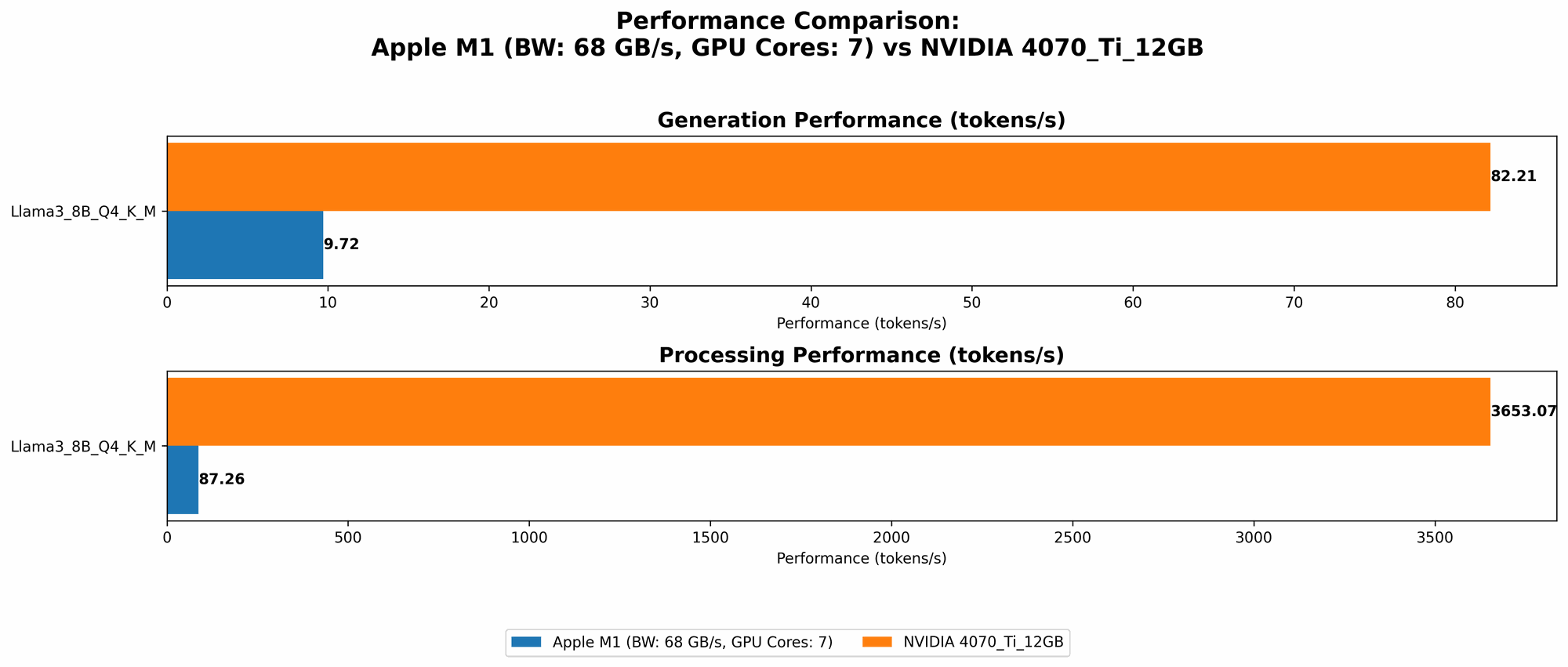
To gain a clearer understanding of each device's performance, let's examine the token generation speeds for specific LLM models. The following table summarizes the key performance metrics from our analysis:
| Model | Quantization | M1 68GB 7 Cores (Tokens/Second) | 4070 Ti 12GB (Tokens/Second) |
|---|---|---|---|
| Llama 2 7B | Q8/0 | 7.92 | NA |
| Llama 2 7B | Q4/0 | 14.19 | NA |
| Llama 3 8B | Q4/K/M | 9.72 | 82.21 |
| Llama 3 8B | Q4/K/M | 3653.07 (Processing) |
Note: NA indicates that data was not available for that specific model and device combination.
Analysis of Token Generation Speeds
From the table above, we see that the M1 68GB 7 cores performs well with smaller models like Llama 2 7B and Llama 3 8B when using quantized models. The M1 is particularly impressive with Q4/0 quantization, reaching over 14 tokens per second for Llama 2 7B. However, the M1's performance remains limited for larger LLMs like Llama 3 70B due to restrictions in FP16 processing.
The NVIDIA 4070 Ti 12GB excels with Llama 3 8B, achieving a remarkable token generation speed well over 80 tokens per second for Q4/K/M quantization. Its proficiency with larger models is evident in its ability to handle Llama 3 8B with FP16 precision, achieving an astounding 3653.07 tokens per second in processing. However, data for the 4070 Ti with smaller models and quantized models is not yet available for this analysis.
Comparing Strengths and Weaknesses
Apple M1: The M1 is an excellent choice for running smaller LLMs, particularly those using quantized models. Its low power consumption and cost-effective nature make it a strong contender for budget-conscious developers. However, its lack of FP16 support and limited scalability hinder its ability to handle larger models effectively.
NVIDIA 4070 Ti: The 4070 Ti is a high-performance powerhouse, particularly when dealing with larger LLMs. Its exceptional FP16 processing capabilities and generous VRAM make it ideal for demanding tasks. The downside is its higher power consumption, cost, and potential overkill for running smaller LLMs.
Practical Recommendations and Use Cases
When to Choose Apple M1 68GB 7 Cores
- Budget-conscious developers: If you're looking for a cost-effective solution for running smaller LLMs, the M1 is a compelling choice.
- Quantized LLM enthusiasts: If you're working with quantized models, particularly those using Q8/0 or Q4/0, the M1's energy efficiency and performance make it a strong contender.
- Students and researchers: For educational and research purposes, the M1 offers a solid balance of performance and affordability for exploring smaller LLMs.
When to Choose NVIDIA 4070 Ti 12GB
- Large LLM enthusiasts: If you're working with larger LLMs, especially those requiring FP16 precision, the 4070 Ti's performance edge is undeniable.
- High-performance computing: For demanding tasks like real-time inference or complex LLM applications, the 4070 Ti's capabilities are unmatched.
- Enterprise and commercial applications: If speed and scalability are paramount, the 4070 Ti's capabilities are well-suited for production environments.
Conclusion
The choice between the Apple M1 68GB 7 cores and the NVIDIA 4070 Ti 12GB ultimately depends on your specific needs and priorities. The M1 is a budget-friendly option for smaller LLMs, especially those using quantized models, while the 4070 Ti is a high-performance powerhouse ideal for large LLMs and demanding workloads. By analyzing the strengths and weaknesses of each device, you can make an informed decision that aligns with your project's requirements and budget.
FAQ
What are LLMs?
LLMs are a type of artificial intelligence that excel at understanding and generating human-like text. They are trained on massive amounts of text data, enabling them to perform tasks like translation, summarization, and creative writing.
What is Tokenization?
Tokenization is the process of breaking down text into individual units called "tokens." Tokens can be words, punctuation marks, or even sub-word units like morphemes. LLMs rely on tokenization to represent text data in a way they can understand.
What is Quantization?
Quantization is a technique used to reduce the size of LLM models and speed up their inference process. It involves converting high-precision numbers (like floating-point numbers) into lower-precision representations (like integers). This smaller size allows for faster computation without sacrificing too much accuracy. For example, a 10-bit quantized model could represent the same information with fewer bits than a 32-bit floating-point model.
Are GPUs always better than CPUs for LLMs?
Not necessarily. CPUs can be more efficient for smaller LLMs, especially when using quantized models. GPUs excel with larger LLMs that require FP16 computations. Ultimately, the best choice depends on the specific model and workload.
Keywords
LLM, Language Model, Token Generation Speed, Apple M1, NVIDIA 4070 Ti, GPU, CPU, Quantization, Q4/K/M, Q8/0, FP16, Inference, Performance Benchmark, Speed, Efficiency, Cost, Power Consumption, Use Case, Recommendation, Llama 2, Llama 3, 7B, 8B, 70B, AI, Machine Learning, Deep Learning.