7 Cooling Solutions for 24 7 AI Operations with NVIDIA RTX 4000 Ada 20GB x4
Introduction
Imagine a world where your AI models are always ready to answer your questions, generate creative content, or even write code. This isn't just a sci-fi dream anymore, but reality! The key to unlocking this potential lies in large language models (LLMs) – powerful AI systems that can understand and generate human-like text. But running these LLMs efficiently and reliably requires a robust infrastructure, particularly in the realm of GPU power and cooling.
This article dives into the exciting world of running LLMs on the NVIDIA RTX 4000 Ada 20GB x4, a powerful GPU powerhouse. We'll explore seven cooling solutions that ensure your LLMs stay cool and keep churning out those amazing results, day and night.
Whether you're a seasoned developer or just a curious tinkerer, join us as we demystify the world of AI, LLMs, and GPU cooling.
The Powerhouse: Understanding the NVIDIA RTX 4000 Ada 20GB x4
The NVIDIA RTX 4000 Ada 20GB x4 packs a serious punch when it comes to AI and LLM processing. This GPU boasts a whopping 20GB of GDDR6 memory and an impressive Ada Lovelace architecture, known for its advanced capabilities in parallel processing and AI tasks. You'll be surprised how much you can fit on this GPU, including several different LLM models with various quantizations.
But let's be real: with that kind of power comes heat! To keep your LLMs running smoothly, maintaining optimal thermal performance becomes crucial.
Cooling Solutions: Keeping Your LLMs from "Melting Down"
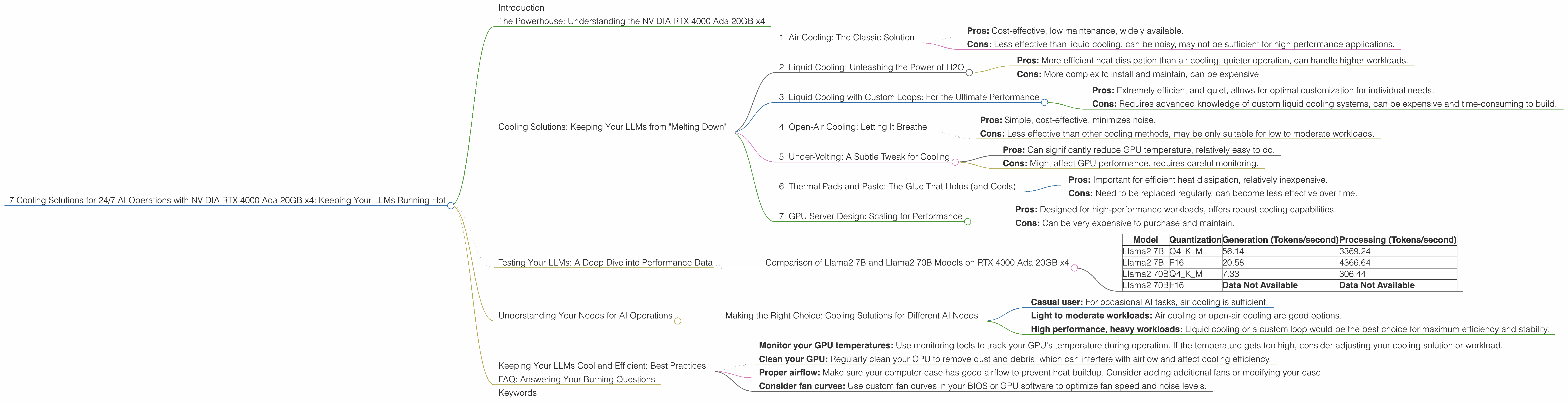
Let's talk about keeping your LLMs running smoothly and preventing them from overheating. Here are seven common approaches to keep your AI operations cool and efficient:
1. Air Cooling: The Classic Solution
Air cooling is the most common and affordable approach to GPU cooling. It utilizes fans to circulate air around the GPU, dissipating heat. Think of it like a gentle breeze on a warm day, keeping you cool and comfortable.
- Pros: Cost-effective, low maintenance, widely available.
- Cons: Less effective than liquid cooling, can be noisy, may not be sufficient for high performance applications.
2. Liquid Cooling: Unleashing the Power of H2O
Liquid cooling takes things to the next level, using a circulating fluid (usually water) to transfer heat away from the GPU. Think of it as a high-performance radiator, keeping your GPU cool under intense pressure.
- Pros: More efficient heat dissipation than air cooling, quieter operation, can handle higher workloads.
- Cons: More complex to install and maintain, can be expensive.
3. Liquid Cooling with Custom Loops: For the Ultimate Performance
If you're looking for the ultimate in cooling performance, custom liquid loops are the way to go. They give you ultimate control over the cooling system, allowing you to fine-tune it for maximum efficiency.
- Pros: Extremely efficient and quiet, allows for optimal customization for individual needs.
- Cons: Requires advanced knowledge of custom liquid cooling systems, can be expensive and time-consuming to build.
4. Open-Air Cooling: Letting It Breathe
Open-air cooling is a simple approach that relies on natural convection to dissipate heat from the GPU. It's like giving your GPU a little extra air circulation, allowing it to cool down naturally.
- Pros: Simple, cost-effective, minimizes noise.
- Cons: Less effective than other cooling methods, may be only suitable for low to moderate workloads.
5. Under-Volting: A Subtle Tweak for Cooling
Under-volting involves reducing the voltage supplied to the GPU, which can help lower its operating temperature. It's like a "cool down" button for your GPU, allowing it to run at lower temperatures while still delivering good performance.
- Pros: Can significantly reduce GPU temperature, relatively easy to do.
- Cons: Might affect GPU performance, requires careful monitoring.
6. Thermal Pads and Paste: The Glue That Holds (and Cools)
Thermal pads and paste are essential components in GPU cooling, helping to transfer heat from the GPU to the cooling solution. Think of them as the "glue" that keeps everything together and allows heat to be transferred efficiently.
- Pros: Important for efficient heat dissipation, relatively inexpensive.
- Cons: Need to be replaced regularly, can become less effective over time.
7. GPU Server Design: Scaling for Performance
For truly large-scale LLM operations, a GPU server with a dedicated cooling system is essential. These systems are designed to handle the extreme heat generated by multiple GPUs, ensuring optimal performance and stability.
- Pros: Designed for high-performance workloads, offers robust cooling capabilities.
- Cons: Can be very expensive to purchase and maintain.
Testing Your LLMs: A Deep Dive into Performance Data
We're going to put our RTX 4000 Ada 20GB x4 GPU to the test for different LLMs with various configurations. To understand these results, let's define some key terms:
- Quantization: A technique to reduce the size of an LLM by simplifying the numerical representation of its parameters, leading to faster processing and lower memory usage. Think of it like a "compressed" version of the LLM that takes up less space and runs faster. Q4KM refers to a specific type of quantization using 4 bits per parameter. F16 uses a 16-bit floating-point representation for model weights.
- Generation: This metric measures the speed at which the LLM can generate new text. It's like the "typing speed" of your LLM. Tokens/second represents the number of tokens (individual words or parts of words) that the model can process per second.
- Processing: This metric represents the speed at which the LLM can process existing text. Imagine this as the "reading speed" of your LLM.
Comparison of Llama2 7B and Llama2 70B Models on RTX 4000 Ada 20GB x4
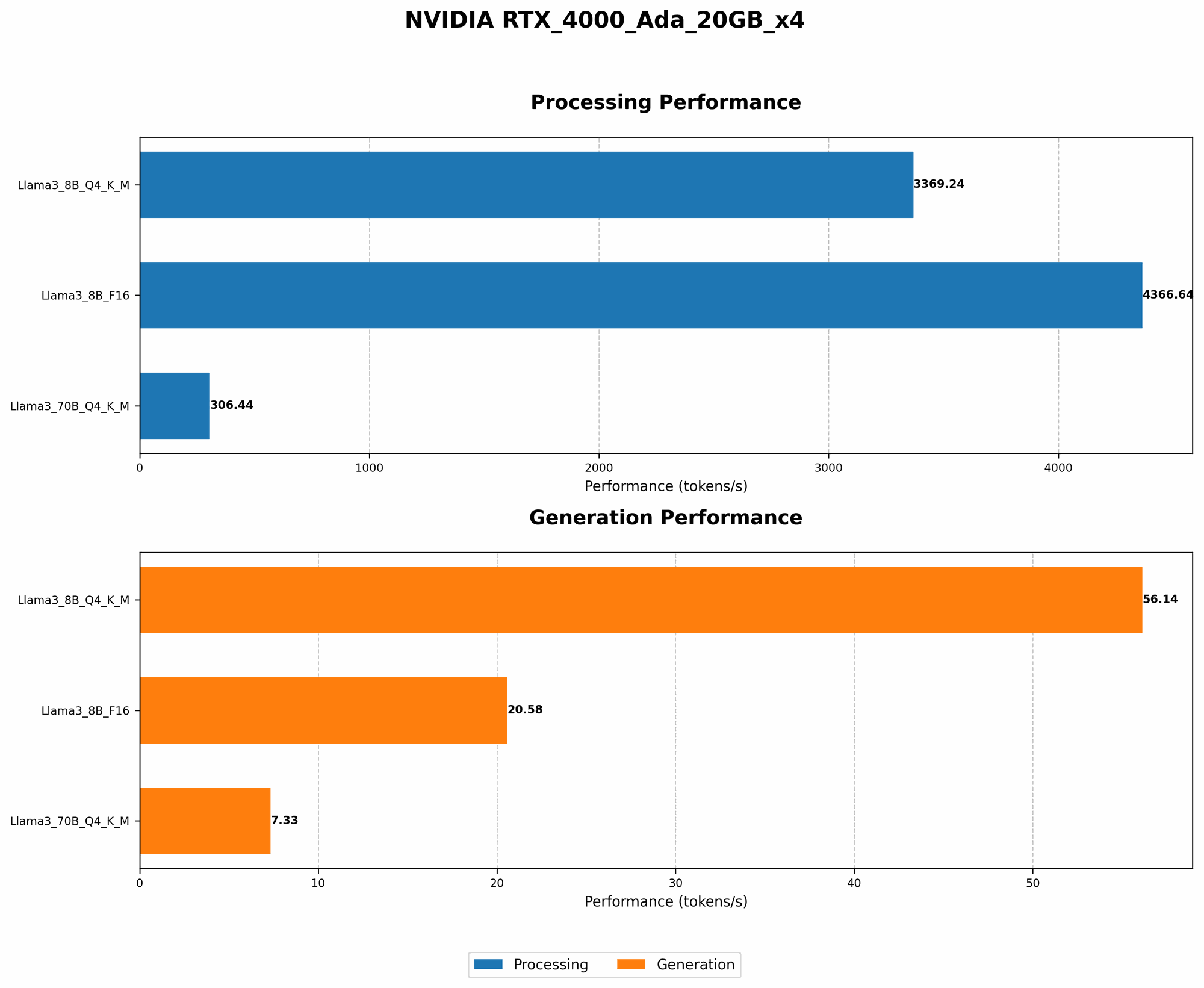
Let's dive into the performance data and see how the RTX 4000 Ada 20GB x4 handles different models. The table below presents the results of running Llama 2 7B and Llama 2 70B models on this GPU under various configurations.
| Model | Quantization | Generation (Tokens/second) | Processing (Tokens/second) |
|---|---|---|---|
| Llama2 7B | Q4KM | 56.14 | 3369.24 |
| Llama2 7B | F16 | 20.58 | 4366.64 |
| Llama2 70B | Q4KM | 7.33 | 306.44 |
| Llama2 70B | F16 | Data Not Available | Data Not Available |
Key Observations:
- Llama 2 7B: The performance of the Llama2 7B model is impressive, generating a solid 56.14 tokens/second with Q4KM quantization and 20.58 tokens/second with F16. For processing, the Q4KM version excels at 3369.24 tokens/second, while the F16 version surprisingly surpasses it at 4366.64 tokens/second. This shows that even with a smaller model, the RTX 4000 Ada 20GB x4 can handle large workloads.
- Llama 2 70B: Moving to the larger Llama 2 70B model does impact performance as expected. While it still performs well with Q4KM quantization (7.33 tokens/second for generation and 306.44 tokens/second for processing), the performance drops significantly compared to the 7B model. It's important to note that the F16 performance data is not available for this model.
Insights for Choosing Your Model and Configuration:
- Smaller models are faster: The 7B model consistently outperforms the 70B model, highlighting the trade-off between model size and performance. If speed is a priority, consider opting for a smaller model.
- Quantization matters: Quantization can significantly impact performance, as seen in the different speeds between the Q4KM and F16 configurations. If you prioritize speed, explore different quantization methods.
Understanding Your Needs for AI Operations
Now that we have a better understanding of the RTX 4000 Ada 20GB x4 and its performance with various LLMs, let's think about how you can choose the ideal cooling solution for your specific needs.
Ask yourself:
- How demanding is your AI workload? If you're working with very large LLMs or running computationally intensive tasks, liquid cooling or a custom loop might be necessary.
- How much noise are you willing to tolerate? Air cooling can be noisy, especially under heavy load, while liquid cooling is significantly quieter.
- What is your budget? Liquid cooling and custom loops can be expensive, while air cooling is more budget-friendly.
Making the Right Choice: Cooling Solutions for Different AI Needs
Here's a quick guide to help you choose the right cooling solution based on your specific AI workload:
- Casual user: For occasional AI tasks, air cooling is sufficient.
- Light to moderate workloads: Air cooling or open-air cooling are good options.
- High performance, heavy workloads: Liquid cooling or a custom loop would be the best choice for maximum efficiency and stability.
Keeping Your LLMs Cool and Efficient: Best Practices
To ensure your LLMs stay cool and keep running smoothly, here are some additional tips:
- Monitor your GPU temperatures: Use monitoring tools to track your GPU's temperature during operation. If the temperature gets too high, consider adjusting your cooling solution or workload.
- Clean your GPU: Regularly clean your GPU to remove dust and debris, which can interfere with airflow and affect cooling efficiency.
- Proper airflow: Make sure your computer case has good airflow to prevent heat buildup. Consider adding additional fans or modifying your case.
- Consider fan curves: Use custom fan curves in your BIOS or GPU software to optimize fan speed and noise levels.
FAQ: Answering Your Burning Questions
Q: What are the best cooling solutions for the RTX 4000 Ada 20GB x4?
A: The best cooling solution depends on your workload and budget. For heavy workloads, liquid cooling or a custom loop is recommended. For moderate workloads, air cooling or open-air cooling are good options.
Q: Can under-volting improve cooling on the RTX 4000 Ada 20GB x4?
A: Yes, under-volting can significantly reduce GPU temperature, but it might also impact performance. Experiment carefully and monitor your GPU's performance.
Q: What if my GPU is already overheating?
A: If your GPU is overheating, it's important to address the issue as soon as possible. Check your cooling solution, make sure your system has good airflow, and consider under-volting or upgrading your cooling system.
Q: Are there any specific recommendations for thermal pads and paste?
A: Choosing the right thermal pads and paste is crucial. High-quality thermal pads and paste will ensure efficient heat dissipation. Check out reviews and recommendations from reputable sources.
Keywords
NVIDIA RTX 4000 Ada 20GB x4, LLM, large language model, GPU cooling, air cooling, liquid cooling, custom loop, open-air cooling, under-volting, thermal pads, thermal paste, GPU server, Llama2, quantization, Q4KM, F16, generation, processing, tokens/second, AI performance, GPU temperature, fan curve, best practices, AI workloads, AI operations, cooling solutions.