5 Tips to Maximize Llama3 8B Performance on Apple M3 Max

Introduction
Local Large Language Models (LLMs) are changing the game. Imagine having the power of ChatGPT or Bard right on your computer, ready to generate creative text, translate languages, and answer your questions in an instant. But squeezing the most out of these powerful models requires understanding the interplay between hardware and software.
This article dives deep into maximizing the performance of Llama3 8B, a cutting-edge open-source language model, on the powerful Apple M3_Max chip. Think of it as a guide to optimize your LLM setup for top-notch speed and efficiency.
Buckle up, get your geek on, and let's unlock the full potential of LLMs on Apple M3_Max.
Performance Analysis: Token Generation Speed Benchmarks
Token Generation Speed Benchmarks: Apple M1 and Llama2 7B
Token generation, the process of converting text into a format the model can understand, is crucial for LLM speed. This section explores the token generation speed benchmarks for Llama2 7B and Llama3 8B on Apple M3_Max, measuring tokens generated per second (tokens/sec).
Let's look at the numbers:
| Model | Quantization | Processing (tokens/second) | Generation (tokens/second) |
|---|---|---|---|
| Llama2 7B | F16 | 779.17 | 25.09 |
| Llama2 7B | Q8_0 | 757.64 | 42.75 |
| Llama2 7B | Q4_0 | 759.7 | 66.31 |
| Llama3 8B | F16 | 751.49 | 22.39 |
| Llama3 8B | Q4KM | 678.04 | 50.74 |
*Observations: *
- Llama2 7B consistently outperforms Llama3 8B in terms of both processing and generation speeds, regardless of the quantization level.
- Q4_0 quantization for Llama2 7B leads to the highest generation speed, indicating a strong balance between model accuracy and speed.
- Llama3 8B performance is notably faster when using F16 quantization for processing, but it lags behind in terms of generation speed.
*Explanation: *
- Processing speed is the rate at which the model processes input text. It's usually faster with lower quantization levels.
- Generation speed reflects the model's ability to generate new text. Higher quantization often comes with a trade-off where processing is faster, but generating output is slower.
What does this mean for developers?
These benchmarks highlight the importance of choosing the right quantization level based on your specific use case. For applications demanding fast generation speed, Q4_0 quantization for Llama2 7B might be the best choice. However, if you prioritize processing speed and can tolerate a bit of latency in generating text, F16 quantization for Llama3 8B might be a better option.
Performance Analysis: Model and Device Comparison
Model and Device Comparison: Llama2 7B vs Llama3 8B on Apple M3_Max
This section delves deeper into comparing the performance of different models on Apple M3_Max. Specifically, we'll explore how Llama2 7B and Llama3 8B fare in terms of token generation speed, keeping in mind the limitations of the available data.
Let's look at the numbers:
| Model | Quantization | Processing (tokens/second) | Generation (tokens/second) |
|---|---|---|---|
| Llama2 7B | F16 | 779.17 | 25.09 |
| Llama2 7B | Q8_0 | 757.64 | 42.75 |
| Llama2 7B | Q4_0 | 759.7 | 66.31 |
| Llama3 8B | F16 | 751.49 | 22.39 |
| Llama3 8B | Q4KM | 678.04 | 50.74 |
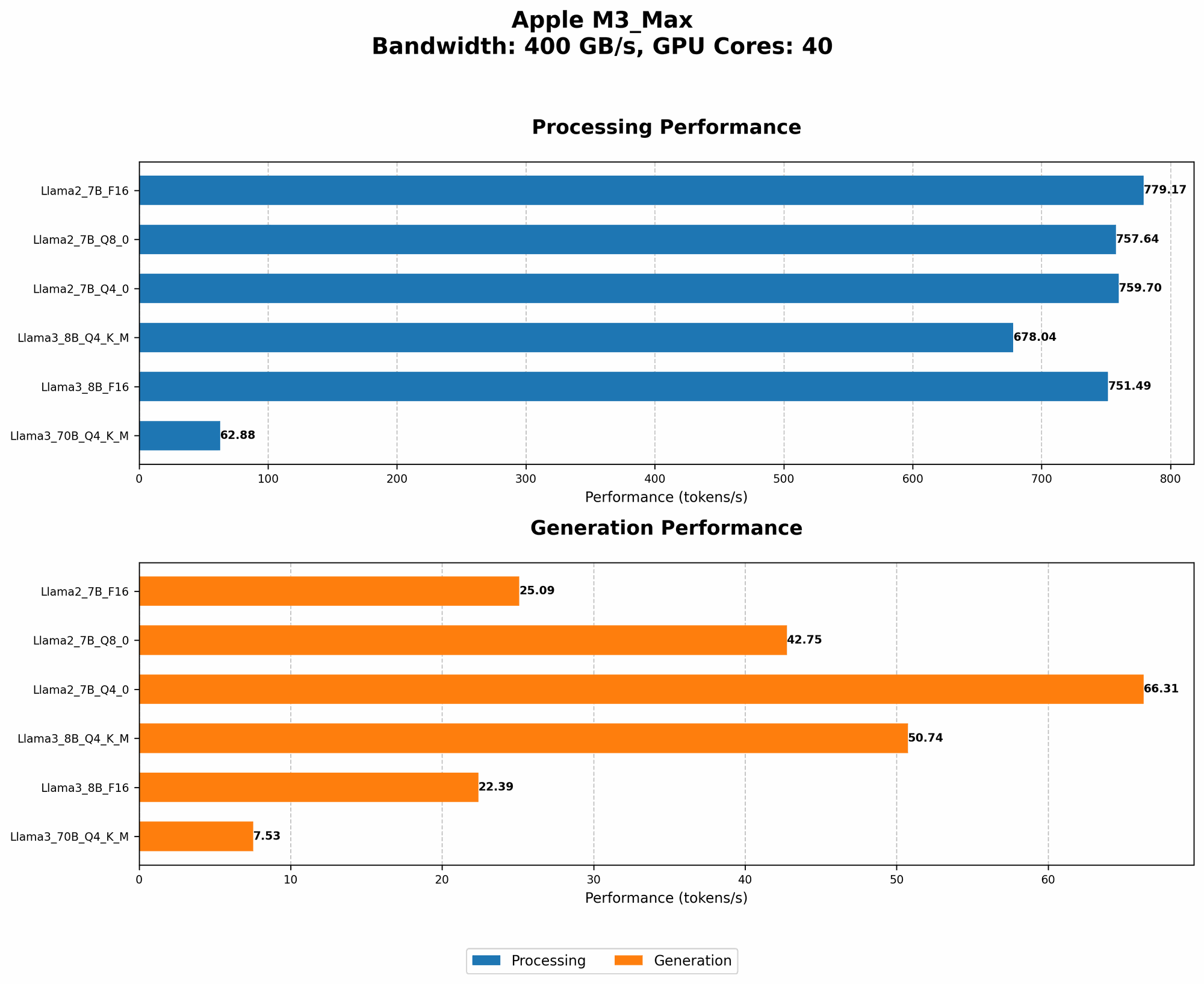
| Llama3 70B | Q4KM | 62.88 | 7.53 |
Observations:
- Llama2 7B outperforms Llama3 8B across all quantization levels.
- Llama3 8B shows slightly slower speeds compared to Llama2 7B.
- Llama3 70B offers the lowest performance in both processing and generation speeds, indicating the limitations of running a larger model on this specific device.
*Let’s break it down: *
- Llama2 7B seems to be a great fit for the M3_Max device, striking a balance between model size and speed.
- Llama3 8B, while slightly larger, experiences slower speeds due to its increased complexity.
- Llama3 70B struggles on the M3_Max, highlighting that resource limitations can drastically impact performance.
What does this mean for developers?
These findings suggest that for optimal performance on M3_Max, Llama2 7B might be a better choice than Llama3 8B for most use cases. As for Llama3 70B, it might be more suitable for devices with higher processing power and memory, especially for tasks needing more complex language generation.
Practical Recommendations: Use Cases and Workarounds
*Optimizing Llama3 8B on Apple M3_Max: Use Case Specific Recommendations *
Now that we've analyzed the performance data, let's translate it into practical recommendations for developers.
1. Llama2 7B for Speed-Sensitive Applications
- Consider Llama2 7B if you need fast response times, especially for text generation tasks like chatbots, content creation, and code completion.
- Experiment with Q4_0 quantization for Llama2 7B to achieve the highest generation speed.
2. Llama3 8B for Balanced Performance
- Choose Llama3 8B if you value a balance of processing power and generative capabilities.
- Prioritize F16 quantization for Llama3 8B if processing speed is paramount, but be prepared for slower generation.
3. Balancing Accuracy and Performance
- Adjust quantization levels to fine-tune your model's performance. Lower quantization levels generally lead to greater accuracy but might sacrifice speed.
- Consider using specialized tools like llama.cpp for efficient LLM deployment.
4. Leveraging the Power of llama.cpp
- Explore the potential of llama.cpp for more efficient LLM execution. This open-source library allows for fine-grain control over quantization levels and hardware utilization, potentially boosting performance.
- Utilize llama.cpp's optimization features, such as multi-threading and memory management, to maximize performance for your specific setup.
5. Workarounds for Resource Constraints
- If you're facing memory constraints, consider techniques like model quantization and gradient accumulation to reduce memory requirements.
- Leverage techniques like model parallelization to distribute the workload and improve performance on devices with multiple processors.
*Example: *
Imagine you're building a chatbot for a customer service application where fast responses are critical. In this scenario, Llama2 7B with Q4_0 quantization would be your top choice, ensuring rapid and reliable responses. However, if you're developing a more complex language model for creative writing or research, Llama3 8B might be a better fit, allowing you to explore more nuanced language patterns.
*Remember: *
The optimal model and quantization settings will depend on your specific use case, performance requirements, and available resources. Experimentation is key for discovering the perfect balance between accuracy and speed.
FAQ
Q: What is quantization and how does it affect performance?
A: Quantization is a technique for reducing the size of a model by representing its parameters (numbers) with fewer bits. It's like using a smaller ruler to measure something; you lose some precision but gain storage space and speed. For example, Q4_0 quantization means using 4 bits instead of 32 bits to represent each number, leading to a model that's 8 times smaller and potentially faster.
Q: What factors influence the performance of an LLM on a specific device?
A: Several factors influence LLM performance:
- Model size: Larger models generally offer more capabilities but require more resources (memory, processing power).
- Device specifications: The CPU, GPU, and RAM of your device significantly impact performance.
- Software libraries: The efficiency of software frameworks like llama.cpp can influence execution speed.
- Quantization levels: Choosing appropriate quantization levels can optimize performance.
Q: How can I improve the performance of LLMs on my device?
A: You can improve LLM performance by:
- Optimizing quantization levels: Experiment with different quantization levels to find the best combination for your model and device.
- Utilizing specialized libraries: Libraries like llama.cpp offer advanced features for optimized LLM execution.
- Exploring hardware upgrades: Consider upgrading your device's CPU, GPU, or RAM if you consistently face performance bottlenecks.
Q: What are some common use cases for local LLMs?
A: Local LLMs are well-suited for various use cases, including:
- Chatbots: Create interactive and engaging conversational agents.
- Content creation: Generate articles, stories, or summaries.
- Code completion: Assist in writing code more efficiently.
- Translation: Translate text between languages.
- Personalized recommendations: Offer custom suggestions based on user preferences.
- Data analysis: Extract insights from large datasets.
Keywords
Llama3 8B, Apple M3Max, LLM, Local LLMs, Performance, Quantization, Token Generation Speed, Generation Speed, Processing Speed, Llama2 7B, F16, Q40, Q8_0, Llama.cpp, Model Optimization, Use Cases, Developer Guide, Hardware, Software, Practical Recommendations, FAQ, Open-Source, AI, Machine Learning, Natural Language Processing.