5 Cooling Solutions for 24 7 AI Operations with NVIDIA 3080 Ti 12GB
Introduction
Imagine this: you've just trained a massive language model (LLM) like the incredible Llama 3, eager to unleash its text-generating prowess. But as you watch your AI chatbot churn out witty responses, a nagging question pops up: "How do I keep this beast running 24/7 without turning my computer into a molten inferno?"
This is where the art of cooling comes in. Running powerful LLMs like Llama 3 demands serious computational horsepower, pushing your hardware to its limits. We're talking about generating thousands of tokens per second, which is like typing at the speed of light! This intense processing can generate a lot of heat, potentially leading to performance throttling and even hardware damage.
This article dives into the world of cooling solutions specifically for the NVIDIA 3080 Ti 12GB GPU, a popular choice for running LLMs locally. We'll explore different approaches, compare their effectiveness, and equip you with the knowledge to keep your AI operation running smoothly and efficiently, day and night.
The Performance of NVIDIA 3080 Ti 12GB: LLMs Go Fast
The NVIDIA 3080 Ti 12GB is a powerhouse GPU, more than capable of handling the heavy lifting involved in running LLMs. To understand the performance we'll be discussing, let's break down some key metrics:
- Tokens per second (Tokens/s): A measure of how fast an LLM can generate text. Think of it like words per minute for a human typist.
- Quantization (Q): A technique for reducing the size of an LLM model, making it faster and more efficient. Think of it like using a smaller dictionary for lookup. Q4KM means the model has been quantized with a 4-bit precision using the "K-BERT" method.
- Generation: This refers to the generation of new text by the LLM. This is what you see in the output of your AI chatbot.
- Processing: This refers to the internal computations required for the LLM to generate text. It's the "thinking" behind the generation.
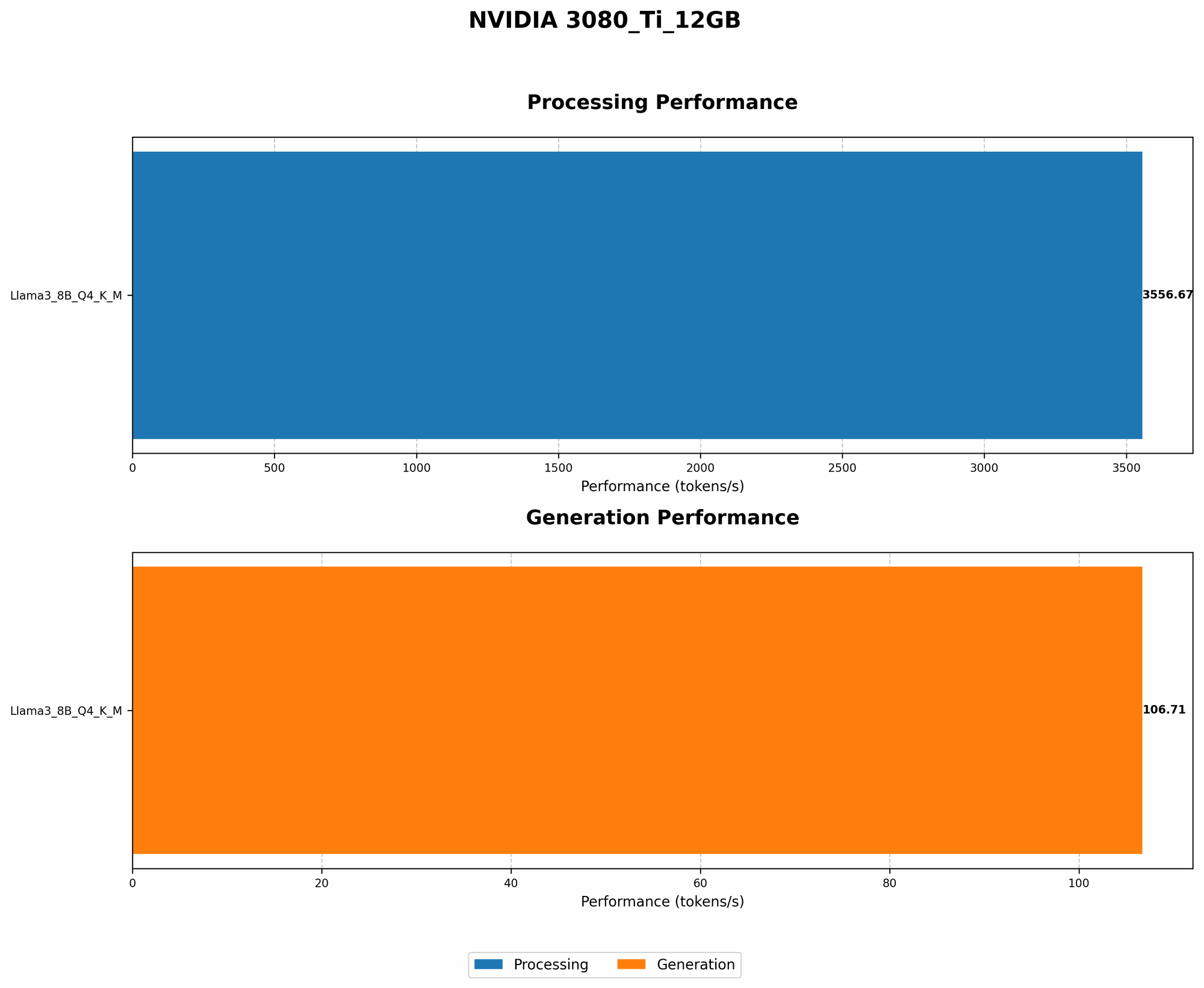
Here's a breakdown of the performance numbers for the NVIDIA 3080 Ti 12GB based on benchmark data:
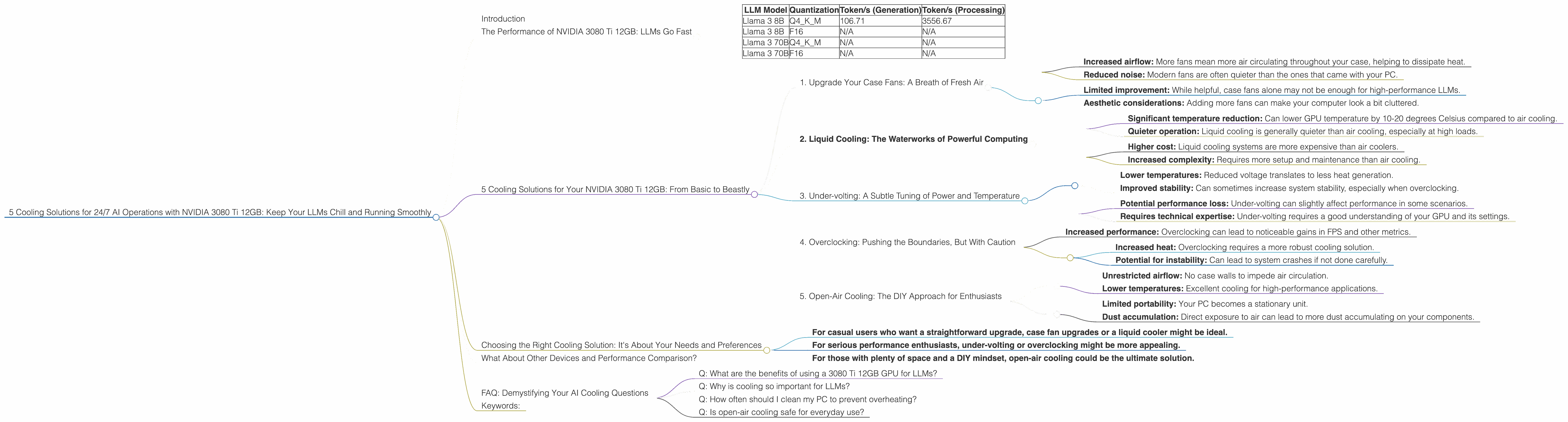
| LLM Model | Quantization | Token/s (Generation) | Token/s (Processing) |
|---|---|---|---|
| Llama 3 8B | Q4KM | 106.71 | 3556.67 |
| Llama 3 8B | F16 | N/A | N/A |
| Llama 3 70B | Q4KM | N/A | N/A |
| Llama 3 70B | F16 | N/A | N/A |
- Note: Unfortunately, benchmark data is not available for Llama 3 70B using either Q4KM or F16 quantization on the 3080 Ti 12GB.
5 Cooling Solutions for Your NVIDIA 3080 Ti 12GB: From Basic to Beastly
Keeping your 3080 Ti 12GB cool is essential to ensuring long-term performance and preventing hardware damage. Here are 5 cooling solutions, ranging from straightforward upgrades to advanced setups:
1. Upgrade Your Case Fans: A Breath of Fresh Air
The simplest way to improve cooling is to upgrade your case fans. Think of it as giving your computer a better ventilation system! This is a cost-effective solution that can make a noticeable difference in temperature. Look for fans with high static pressure, which is important for pushing air through the tight spaces in your PC case.
Benefits:
- Increased airflow: More fans mean more air circulating throughout your case, helping to dissipate heat.
- Reduced noise: Modern fans are often quieter than the ones that came with your PC.
Drawbacks:
- Limited improvement: While helpful, case fans alone may not be enough for high-performance LLMs.
- Aesthetic considerations: Adding more fans can make your computer look a bit cluttered.
2. Liquid Cooling: The Waterworks of Powerful Computing
For serious cooling power, consider liquid cooling. Liquid cooling systems use a circulating fluid to transfer heat away from your GPU. It's like giving your 3080 Ti 12GB a personal swimming pool!
Benefits:
- Significant temperature reduction: Can lower GPU temperature by 10-20 degrees Celsius compared to air cooling.
- Quieter operation: Liquid cooling is generally quieter than air cooling, especially at high loads.
Drawbacks:
- Higher cost: Liquid cooling systems are more expensive than air coolers.
- Increased complexity: Requires more setup and maintenance than air cooling.
3. Under-volting: A Subtle Tuning of Power and Temperature
Under-volting involves manually adjusting the voltage supplied to your GPU, which can reduce its power consumption and heat output. It's like turning down the thermostat on your processing furnace.
Benefits:
- Lower temperatures: Reduced voltage translates to less heat generation.
- Improved stability: Can sometimes increase system stability, especially when overclocking.
Drawbacks:
- Potential performance loss: Under-volting can slightly affect performance in some scenarios.
- Requires technical expertise: Under-volting requires a good understanding of your GPU and its settings.
4. Overclocking: Pushing the Boundaries, But With Caution
Overclocking involves increasing the clock speed of your GPU, boosting performance. But it can also increase heat generation, making cooling even more critical. It's like turning up the engine RPMs and increasing the risk of overheating.
Benefits:
- Increased performance: Overclocking can lead to noticeable gains in FPS and other metrics.
Drawbacks:
- Increased heat: Overclocking requires a more robust cooling solution.
- Potential for instability: Can lead to system crashes if not done carefully.
5. Open-Air Cooling: The DIY Approach for Enthusiasts
Open-air cooling involves placing your PC outside of a case for direct exposure to room air. This can provide excellent cooling, but it requires a lot of space and careful consideration. It's like leaving your computer on a breezy porch for maximum airflow.
Benefits:
- Unrestricted airflow: No case walls to impede air circulation.
- Lower temperatures: Excellent cooling for high-performance applications.
Drawbacks:
- Limited portability: Your PC becomes a stationary unit.
- Dust accumulation: Direct exposure to air can lead to more dust accumulating on your components.
Choosing the Right Cooling Solution: It's About Your Needs and Preferences
The best cooling solution for your 3080 Ti 12GB depends on your individual needs and preferences.
- For casual users who want a straightforward upgrade, case fan upgrades or a liquid cooler might be ideal.
- For serious performance enthusiasts, under-volting or overclocking might be more appealing.
- For those with plenty of space and a DIY mindset, open-air cooling could be the ultimate solution.
Remember to carefully research and understand the implications of each option before implementing it.
What About Other Devices and Performance Comparison?
As the article is focused specifically on the NVIDIA 3080 Ti 12GB, we won't be exploring other devices or comparing their performance. However, if you're curious about how other GPUs stack up, you can find performance benchmarks online for various devices.
FAQ: Demystifying Your AI Cooling Questions
Q: What are the benefits of using a 3080 Ti 12GB GPU for LLMs?
A: The 3080 Ti 12GB delivers high performance for LLMs, especially when using quantized models like Llama 3 8B Q4KM. This means you can enjoy smoother AI interactions and faster processing speeds.
Q: Why is cooling so important for LLMs?
A: LLMs are computationally demanding. High temperatures can cause performance throttling, meaning your AI might slow down or even crash. It can also lead to damage to your hardware over time.
Q: How often should I clean my PC to prevent overheating?
A: It's a good idea to clean your PC every 3-6 months, depending on your environment and how often you use it. Dust accumulation can hinder airflow and lead to higher temperatures.
Q: Is open-air cooling safe for everyday use?
A: Open-air cooling can be safe if done correctly, but it's not recommended for everyday use unless you have sufficient space and a clean environment. Dust and static electricity can pose risks.
Keywords:
NVIDIA 3080 Ti, 12GB, GPU, LLM, Llama 3, Cooling, Performance, Token/s, Quantization, Q4KM, F16, Generation, Processing, Air Cooling, Liquid Cooling, Under-volting, Overclocking, Open-Air, GPU Temperature